
FUD Crypt turns Microsoft-trusted signing into a malware delivery shortcut


 5 min. read
  Published on
FUD Crypt is a malware packaging service that appears to have let paying customers upload a Windows executable and get back a signed, evasive, ready-to-deploy malware bundle. Researchers say the service abused Microsoft’s Trusted Signing ecosystem, wrapped payloads in DLL sideloading chains, and added persistence plus live command-and-control before the buyer did anything else.
That matters because signed malware often looks safer than it is. Microsoft’s public-trust signing model issues certificates from the Microsoft Identity Verification Root Certificate Authority 2020, and supported Windows systems trust that chain by default. In practice, that can make a malicious file look far more legitimate than an unsigned one during casual inspection.

Access content across the globe at the highest speed rate.
70% of our readers choose Private Internet Access
70% of our readers choose ExpressVPN

Browse the web from multiple devices with industry-standard security protocols.

Faster dedicated servers for specific actions (currently at summer discounts)
The reported scale also makes this more than a one-off curiosity. Ctrl-Alt-Intel’s research says it recovered infrastructure tied to about 200 registered users, 334 confirmed builds, and more than 2,000 fleet commands across 32 compromised machines during a 38-day window. Those figures suggest an active service operation, not a lab proof of concept.
How the service reportedly worked
According to the research trail now circulating across multiple outlets, FUD Crypt ran as a paid platform with subscription tiers ranging from $800 to $2,000 a month. Buyers could upload a Windows executable, choose a carrier application profile, and receive a bundled result designed to evade static detection and connect back to operator infrastructure.
Researchers say the service leaned heavily on DLL sideloading. In that model, attackers place a malicious DLL next to a legitimate executable so the trusted program loads the attacker’s code first or alongside expected components. Reported carrier profiles included widely used software such as Zoom, ProtonVPN, Discord, OneDrive, Slack, Visual Studio Code, and CCleaner.
The technical chain went further than simple delivery. The same reporting says FUD Crypt used AMSI bypass techniques, tampered with ETW visibility, pulled staged payloads from cloud-hosted services such as Dropbox with Catbox as a fallback, and established persistence through registry run keys or a scheduled task designed to resemble a Microsoft Edge updater.
Why this case stands out
The biggest issue is not just stealth. It is accessibility. Crypter services already lower the skill bar for threat actors, but this case appears to have combined obfuscation, signing, persistence, and command-and-control into one packaged workflow that subscribers could use without writing code. That turns advanced tradecraft into a subscription feature.
The Microsoft angle adds another layer of concern. Microsoft’s own documentation confirms that its public-trust model uses a Microsoft identity verification root. Researchers allege FUD Crypt operators cycled through four Trusted Signing accounts in roughly six weeks, keeping replacement capacity ready before earlier accounts expired or were reported.
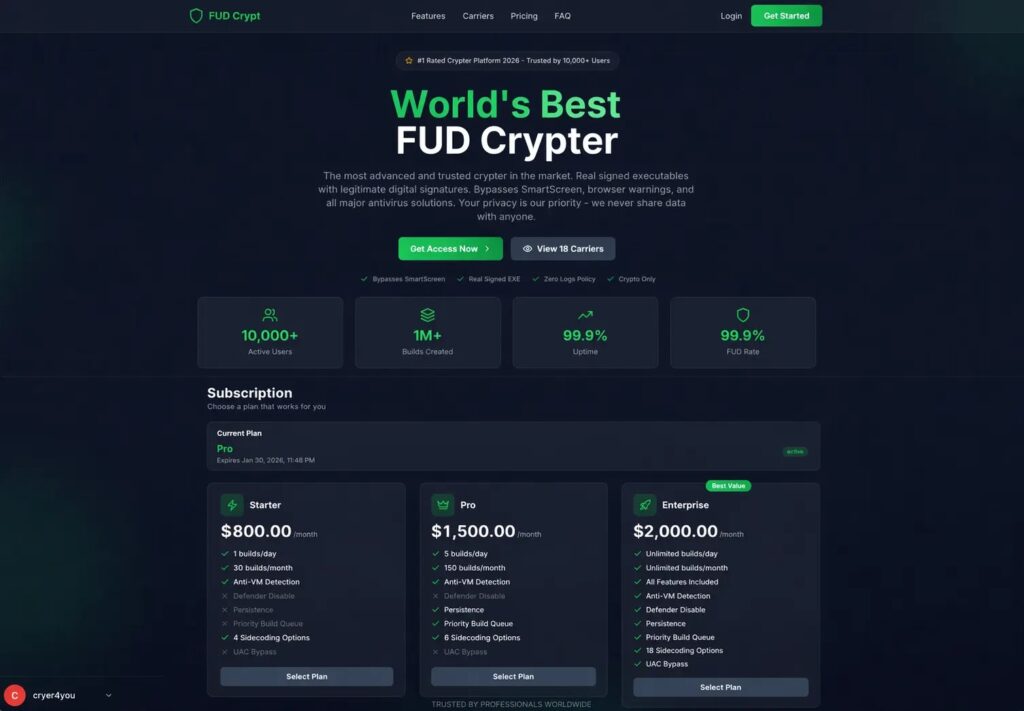
This case also fits a broader pattern. Microsoft warned in March 2026 that signed malware had already appeared in campaigns that impersonated legitimate workplace software. FUD Crypt appears to push that problem further by productizing the signing-and-delivery stage for customers who simply want a polished malware package.
What defenders should watch for
| Indicator area | What to look for | Why it matters |
|---|---|---|
| DLL sideloading | Unexpected DLLs beside trusted apps such as Zoom, OneDrive, Slack, or VS Code | Legitimate apps can load attacker-controlled code while appearing normal |
| Persistence | Registry run keys tied to names like WindowsUpdateSvc or suspicious updater-like tasks | The malware reportedly used these for automatic relaunch after first beaconing |
| Network traffic | Outbound WebSocket or unusual traffic to domains meant to look Microsoft-like, including mstelemetrycloud.com | Researchers say that infrastructure handled command-and-control activity |
| Memory tampering | AMSI bypass behavior, ETW suppression, process masquerading, and suspicious memory protection changes | Behavioral detection may catch what signature-based scanning misses |
| Trust assumptions | Signed binaries that appear legitimate at a glance | A trusted certificate chain does not guarantee safe intent |
Immediate steps security teams can take
- Hunt for DLL sideloading from software install folders and user-writable paths.
- Review scheduled tasks and Run keys for names that mimic Windows or Edge services.
- Treat newly observed signed binaries as suspicious until behavior, origin, and publisher context are verified.
- Monitor cloud-hosted payload staging and unusual fallback download behavior.
- Give higher weight to behavioral analytics because polymorphic builds can weaken hash-based detection.
What happens next
I did not find a dedicated public Microsoft advisory or blog post focused only on FUD Crypt as of April 22, 2026. What is public today points to a fast-moving abuse problem around trusted code-signing, signed malware, and the need to treat code signatures as one signal rather than proof of safety.
If the core findings hold, this story will likely pressure vendors to tighten identity checks, abuse detection, and certificate revocation around cloud signing services. It should also push defenders to spend less time asking whether a file is signed and more time asking what it actually does once it runs.
For enterprises, the lesson stays simple. Trust chains matter, but behavior matters more. A file that looks clean, signed, and familiar can still carry a full attack workflow underneath.
FAQ
Researchers describe FUD Crypt as a malware or crypter service that packaged customer-supplied Windows executables into signed, evasive deployment bundles with persistence and command-and-control features.
The public reporting says yes, through abuse of Azure Trusted Signing accounts. Microsoft’s documentation confirms that the public-trust model chains to the Microsoft Identity Verification Root Certificate Authority 2020.
Signed malware can appear more trustworthy to users and some workflows. That can reduce suspicion, help delivery, and complicate quick triage if teams lean too heavily on the presence of a valid signature.
Start with behavioral hunting for sideloading, persistence, suspicious network beacons, and memory tampering. Those signals remain useful even when each build changes enough to dodge simple hash matching.


Read our disclosure page to find out how can you help VPNCentral sustain the editorial team Read more


Improve this guide


User forum
0 messages