
Mycelium Framework Advertised as First AI-as-a-Service Botnet for Criminal Compute


 7 min. read
  Published on
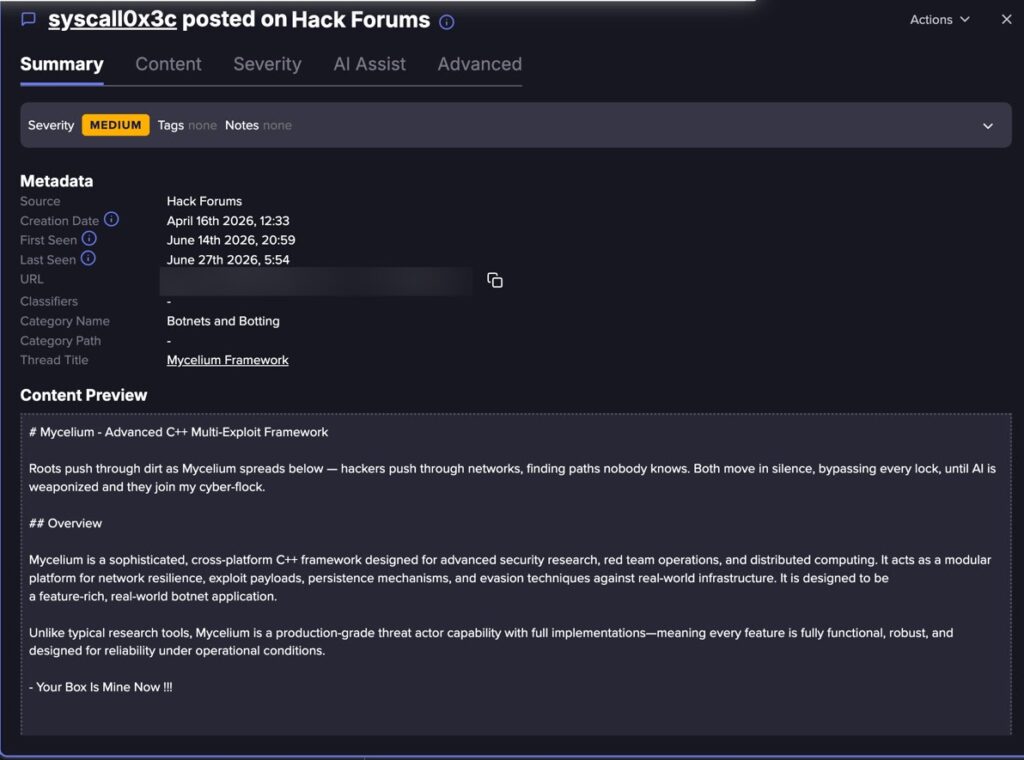
Security researchers have identified an underground advertisement for a botnet-style framework called Mycelium that claims to turn hacked Windows and Linux machines into rented AI computing resources.
The framework was described by Flare as the first underground offering the company has seen that explicitly markets a botnet as an AI-as-a-Service platform instead of a traditional tool for spam, DDoS attacks, ransomware delivery, or credential theft.

Access content across the globe at the highest speed rate.
🔥 Save 81% + 2 bonus months! 🔥
70% of our readers choose Private Internet Access
70% of our readers choose ExpressVPN
2
Browse the web from multiple devices with industry-standard security protocols.
🔥 Save 73%! 🔥

Faster dedicated servers for specific actions (currently at summer discounts)
🔥 Save 69%! 🔥
Mycelium does not appear to introduce an entirely new infection method. Its claimed novelty lies in how it would use compromised machines after infection by sorting them according to CPU power, GPU access, browser sessions, AI API keys, local language models, and enterprise credentials.
What Mycelium claims to offer
The advertised framework combines familiar malware functions with a distributed compute model. It claims to support exploitation, persistence, encrypted command-and-control, credential theft, lateral movement, AI task routing, and plugin-based modules.
According to the Flare report, the framework is presented as a cross-platform C++ system with native paths for Windows and Linux. It also uses a modular design, which would let operators load or replace components without rebuilding the entire tool.
The seller’s pitch suggests that infected machines would act like worker nodes in a criminal compute grid. High-value hosts could run premium AI tasks through stolen API access, while weaker systems could handle lower-cost tasks such as preprocessing, reconnaissance, spam generation, or password cracking support.
| Claimed Mycelium component | Advertised role | Why it matters |
|---|---|---|
| AI task routing | Assigns jobs based on CPU, GPU, local models, AI keys, and active sessions. | Turns infected machines into reusable compute resources. |
| Plugin architecture | Loads modules for exploitation, scanning, browser theft, AI work, and grid computing. | Makes the framework easier to expand and maintain. |
| Encrypted C2 | Uses encrypted operator communication and tasking. | Helps attackers control many hosts while hiding commands. |
| Credential harvesting | Targets browser data, sessions, tokens, and enterprise accounts. | Gives attackers access to AI, developer, messaging, and SaaS platforms. |
| Distributed workloads | Supports AI inference, cracking, scanning, exploit validation, and social engineering. | Moves the botnet model closer to a criminal cloud platform. |
Why the AI-as-a-Service angle is significant
Traditional botnets usually make money through spam, DDoS attacks, proxy traffic, credential theft, ransomware deployment, or cryptocurrency mining. Mycelium’s advertisement instead presents compromised infrastructure as a pool of computing power and account access.
That shift matters because AI workloads can benefit from scale. A single compromised machine may have limited value, but a large group of infected machines could provide GPU cycles, stolen AI subscriptions, local model access, and browser sessions that criminals can route to different tasks.
The advertised model also reflects how legitimate cloud and high-performance computing systems work. Nodes are profiled, tasks are scheduled, failures are retried, and work is routed to the resource that fits the job.
How the framework could abuse stolen AI access
Mycelium’s seller claims the framework can identify machines with premium AI access or local language models. Those machines could then receive higher-value tasks, such as targeted phishing, executive impersonation, exploit drafting, or content generation.
The advertisement also describes a social-engineering engine that studies a victim’s messages and writing style. If attackers also control messaging sessions for Slack, Discord, Telegram, or email, they could send more convincing fraudulent messages from trusted accounts.
Another claimed feature involves monitoring vulnerability sources, generating exploit code with AI tools, validating the output, and distributing working modules across the botnet. That claim may involve marketing exaggeration, but the workflow matches the direction many defenders already worry about.
Old enterprise vulnerabilities still matter
The exploit list in the advertisement reportedly references widely abused enterprise bugs and platforms, including GitLab, Microsoft Exchange, Apache Log4j, F5 BIG-IP, Citrix NetScaler, Atlassian Confluence, VMware vCenter, Fortinet, Apache Struts, Jenkins, Tomcat, Webmin, and JBoss.
Some of those examples have long histories of real-world exploitation. For example, GitLab CVE-2021-22205 was a critical remote command execution issue tied to improper validation of image files, while CISA’s Log4Shell guidance covered the major CVE-2021-44228 remote code execution vulnerability in Apache Log4j.
This is why the Mycelium pitch should concern enterprise defenders even without public malware samples. Attackers do not need new bugs when organizations still expose old services, unpatched systems, weak credentials, and misconfigured remote access.
What security teams should watch for
Flare said many of the individual behaviors may look normal in isolation. Developers use AI services, servers produce CPU spikes, admins run remote tools, and browsers maintain active sessions. The risk appears when those signals combine with persistence, encrypted tasking, credential theft, and unusual AI-service access.
Defenders should treat Mycelium as a warning about where cybercrime may be heading. Even if the full product does not exist exactly as advertised, the underlying pieces already exist across malware, botnets, credential stealers, AI abuse, and exploit automation.
Security teams should prioritize these checks:
- Monitor unusual AI API key usage from servers and developer workstations.
- Baseline CPU, memory, and GPU activity on systems that should not run inference or cracking jobs.
- Investigate sustained encrypted outbound traffic from machines that rarely communicate externally.
- Correlate browser credential theft with logins to AI tools, code repositories, cloud consoles, and messaging platforms.
- Alert on dynamic module loading, suspicious DLL behavior, and unknown plugin-style malware components.
- Review exposed enterprise applications against old high-impact vulnerabilities and missing patches.
Why this is more than another botnet listing
Mycelium’s importance comes from its architecture, not just its malware claims. It packages familiar offensive techniques into a service model built around AI workloads and distributed resource scheduling.
The same pattern could appeal to criminals because compute and premium AI access have direct value. A compromised system with a valid AI subscription, developer tokens, GPU access, or enterprise browser sessions may now be more valuable than a machine used only for spam or proxy traffic.
Organizations should also treat older advisories as active defense priorities. The GitLab advisory and CISA guidance show how long serious enterprise flaws can remain relevant after disclosure.
What this means for AI security
The Mycelium advertisement shows how the value of compromised machines is changing. Attackers can still steal credentials, move laterally, and deploy malware, but they may increasingly monetize infected systems as AI workers, inference nodes, cracking nodes, and social-engineering engines.
That creates a new detection problem. Security tools need to recognize not only malware execution, but also suspicious AI usage, stolen session chaining, abnormal GPU consumption, and workload-style behavior across ordinary endpoints.
The safest assumption is that AI abuse will not remain separate from traditional malware. Mycelium points to a future where botnets, stolen accounts, local models, and automated exploitation merge into one criminal service layer.
FAQ
Mycelium Framework is an underground-advertised botnet-style platform that claims to turn compromised Windows and Linux machines into AI computing resources for criminals.
Public reporting describes Mycelium as an underground advertisement analyzed by researchers. The seller did not release public source code or proof of execution, so its full implementation remains unconfirmed.
Traditional botnets often focus on spam, DDoS attacks, credential theft, proxy abuse, or ransomware delivery. Mycelium is different because it claims to classify infected machines by compute power, AI access, local models, and stolen sessions, then route AI and other workloads across them.
Organizations should monitor unusual AI API usage, unexpected GPU or CPU spikes, encrypted outbound traffic, browser credential theft, suspicious plugin loading, and unusual logins to AI, developer, cloud, and messaging platforms after suspicious endpoint activity.


Read our disclosure page to find out how can you help VPNCentral sustain the editorial team Read more


Improve this guide




User forum
0 messages