
Pack2TheRoot Flaw Gives Local Linux Users a Path to Root Access


 6 min. read
  Published on

A newly disclosed Linux vulnerability called Pack2TheRoot can let a local unprivileged user gain root access through PackageKit, the system service used by many Linux distributions to manage software installation, updates, and removal. The flaw is tracked as CVE-2026-41651 and carries a high CVSS score of 8.8.
The bug affects PackageKit versions 1.0.2 through 1.3.4 and has existed for more than 12 years. PackageKit 1.3.5 fixes the issue, and Linux users should install distribution updates as soon as they become available.

Access content across the globe at the highest speed rate.
70% of our readers choose Private Internet Access
70% of our readers choose ExpressVPN

Browse the web from multiple devices with industry-standard security protocols.

Faster dedicated servers for specific actions (currently at summer discounts)
Deutsche Telekom’s Red Team discovered the vulnerability during research into Linux local privilege escalation paths. The team said it first noticed unusual behavior when pkcon install could install a system package without requiring a password on a Fedora Workstation system.
What Pack2TheRoot does
Pack2TheRoot is a local privilege escalation flaw. That means an attacker already needs local access to the machine, but once they have it, they may be able to abuse PackageKit to install or remove packages with root privileges.
NVD describes the flaw as a time-of-check time-of-use race condition on transaction flags. In simpler terms, PackageKit can check whether an operation is allowed, but the conditions can change before the action completes. That gap can let an unprivileged user perform package operations as root.
This matters because package installation is a trusted system-level action. If an attacker can control what gets installed or removed, they may be able to add malicious software, replace components, break security controls, or create a direct route to root access.
At a glance
| Item | Details |
|---|---|
| Vulnerability | CVE-2026-41651 |
| Nickname | Pack2TheRoot |
| Affected component | PackageKit daemon |
| Affected versions | PackageKit 1.0.2 through 1.3.4 |
| Fixed version | PackageKit 1.3.5 |
| Severity | High |
| CVSS score | 8.8 |
| Vulnerability type | Local privilege escalation |
| Root cause | TOCTOU race condition on transaction flags |
| Main risk | Unprivileged local users can install or remove packages as root |
| Public exploit details | Withheld to give patches time to spread |
Which Linux systems are affected
Deutsche Telekom’s Red Team said it is safe to assume that Linux distributions with PackageKit installed and enabled by default may be vulnerable if they use an affected version. The team confirmed exploitability on several distributions using apt and dnf package manager backends.
Tested systems included Ubuntu Desktop 18.04, 24.04.4, and 26.04 beta, Ubuntu Server 22.04 through 24.04, Debian Desktop Trixie 13.4, Rocky Linux Desktop 10.1, Fedora 43 Desktop, and Fedora 43 Server. The list is not exhaustive.
Ubuntu’s CVE page also rates the issue as high severity, with local attack vector, low attack complexity, low privileges required, and no user interaction required.
Why PackageKit creates a broad attack surface
PackageKit provides a D-Bus abstraction layer for package management across Linux distributions. It helps desktop tools, update managers, and management software interact with package systems in a consistent way.
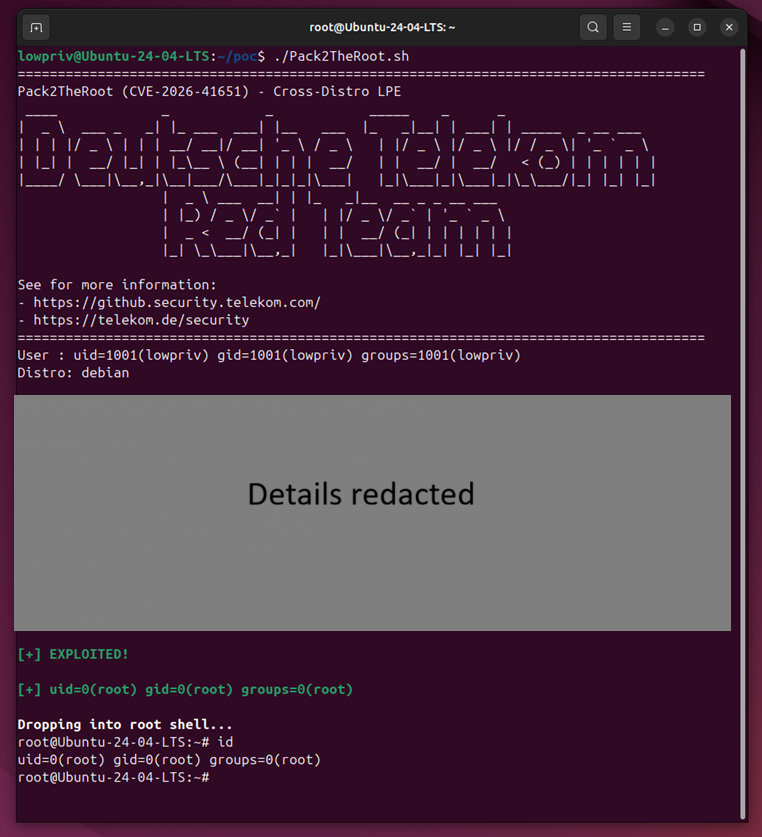
Source: Deutsche Telekom
That makes the flaw important beyond one distribution. PackageKit is common on desktop Linux systems and can also appear on servers where management tools depend on it.
The issue does not give a remote attacker instant access from the internet. However, it becomes serious once an attacker has a local foothold through a stolen account, malware, exposed service, container escape path, or compromised low-privilege user.
What has been fixed
PackageKit maintainers released version 1.3.5 to address CVE-2026-41651. The maintainer urged users and distributions to update quickly, noting that the vulnerability can allow arbitrary package installation or removal and can lead to a local root exploit on most systems.
Technical details and a full demo exploit were not released with the initial disclosure. Deutsche Telekom’s Red Team said this gives distributions and users time to apply patches before attackers can widely copy the technique.
Red Hat also confirmed the issue as a PackageKit flaw involving a TOCTOU race condition that lets unprivileged users install packages.
How to check if your system may be vulnerable
Linux users can check whether PackageKit is installed and which version is present. Debian and Ubuntu users can run:
dpkg -l | grep -i packagekit
Fedora, Rocky Linux, and other RPM-based users can run:
rpm -qa | grep -i packagekit
Users can also check whether the daemon is running with:
systemctl status packagekit
Another option is:
pkmon
If PackageKit is installed, enabled, and older than 1.3.5, the system should be treated as potentially vulnerable until distribution patches are applied.
What administrators should do now
- Install PackageKit security updates from your Linux distribution.
- Upgrade to PackageKit 1.3.5 or the patched package provided by your vendor.
- Check desktop and server systems, especially shared Linux machines.
- Review whether PackageKit needs to run on servers.
- Disable or remove PackageKit where it is not required.
- Watch system logs for PackageKit crashes or assertion failures.
- Prioritize multi-user systems, developer workstations, lab machines, and systems with untrusted local users.
- Review recent package installation and removal history for suspicious activity.
Why local privilege escalation still matters
Local privilege escalation flaws often get less attention than remote code execution bugs because they require local access first. That can create a false sense of safety.
In real attacks, local access is often the middle stage. Attackers may first enter through phishing, stolen SSH credentials, a vulnerable web app, or malware. Once inside, a flaw like Pack2TheRoot can help them turn a low-privilege account into full root control.
Root access changes the impact. An attacker can tamper with logs, install persistence, access other users’ files, dump secrets, disable security tools, or use the machine to move deeper into the network.
Signs defenders should review
Deutsche Telekom’s Red Team said exploitation can cause the PackageKit daemon to hit an assertion failure and crash. Even if systemd restarts the service, the crash can leave traces in system logs.
Administrators should review logs for unusual PackageKit failures, unexpected package changes, or suspicious pkcon activity. Package installation history may also help identify systems that require deeper investigation.
A patch closes the vulnerability going forward, but it does not automatically prove the system was never abused. Shared Linux environments and systems with multiple local users deserve extra review.
FAQ
Pack2TheRoot is the nickname for CVE-2026-41651, a local privilege escalation vulnerability in PackageKit that can let unprivileged Linux users install or remove packages as root.
PackageKit versions 1.0.2 through 1.3.4 are affected. Version 1.3.5 contains the fix.
No. The flaw requires local access. However, attackers can use it after gaining a low-privilege foothold on a Linux system.
Researchers confirmed exploitability on several Ubuntu, Debian, Fedora, and Rocky Linux systems. Other distributions may also be affected if they ship a vulnerable PackageKit version.


Read our disclosure page to find out how can you help VPNCentral sustain the editorial team Read more


Improve this guide



User forum
0 messages