
Taiwan High Speed Rail reviews radio security after spoofed alarm halts trains


 5 min. read
  Published on
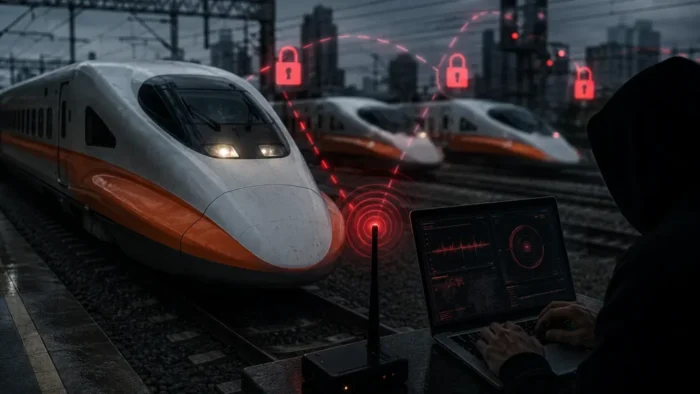
Taiwan High Speed Rail is reviewing its radio security after a spoofed emergency alarm disrupted train service during the Qingming Festival holiday period. Initial reports said three operating trains made emergency stops, while later transport committee reporting said four trains temporarily halted.
The incident happened at 11:23 p.m. on April 5, 2026. Taiwan High Speed Rail’s control center received a General Alarm signal that appeared to come from a TETRA handheld radio linked to Taichung Station.

Access content across the globe at the highest speed rate.
🔥 Save 81% + 2 bonus months! 🔥
70% of our readers choose Private Internet Access
70% of our readers choose ExpressVPN
2
Browse the web from multiple devices with industry-standard security protocols.
🔥 Save 73%! 🔥

Faster dedicated servers for specific actions (currently at summer discounts)
🔥 Save 69%! 🔥
The alert triggered emergency procedures, and train drivers switched to manual braking. Services resumed at 11:43 p.m., but the incident caused a total delay of 48 minutes.
What happened during the rail disruption
Investigators say the suspect, a 23-year-old university student surnamed Lin, used radio equipment to imitate parameters used by Taiwan High Speed Rail’s communication system. Prosecutors later released him on NT$100,000 bail after questioning.
Local reports said Taiwan High Speed Rail checked its internal devices after the alarm and found that no authorized handheld radios were missing. The company then reported the incident to police and filed a formal complaint.
The case now involves the Railway Police Bureau, the Criminal Investigation Bureau’s Electronic Investigation Brigade, and the Taoyuan District Prosecutors’ Office. Authorities seized radio communication equipment and electronic devices during searches at several locations.
At a glance
| Detail | Information |
|---|---|
| Operator | Taiwan High Speed Rail Corp |
| Incident date | April 5, 2026 |
| Time | 11:23 p.m. |
| Signal involved | TETRA General Alarm signal |
| Operational impact | Emergency stops and a 48-minute total delay |
| Trains affected | Initial reports said three trains; later transport committee reporting said four |
| Suspect | 23-year-old university student surnamed Lin |
| Legal status | Released on NT$100,000 bail pending further proceedings |
How the alleged spoofing worked
TETRA systems support secure radio communication for transport, emergency services, and critical infrastructure teams. In rail environments, these radios help staff and control centers exchange urgent operational messages.
According to investigators cited in local reporting, Lin used software-defined radio tools to analyze Taiwan High Speed Rail signals. He then allegedly cracked communication parameters and programmed them into handheld radio devices.
That let him send a General Alarm signal that the rail control center treated as legitimate. Because the system links that alert to passenger and train safety, the control center followed procedure and warned trains in the affected area.
Why the incident matters
This was not a normal IT breach involving stolen files or leaked passwords. It was a cyber-physical incident, because a forged communication signal affected real train operations.
The disruption also shows how radio systems can become part of critical infrastructure risk. If an attacker can imitate a trusted operational signal, safety systems may react exactly as designed, even when the alert itself is false.
That makes the case important beyond Taiwan. Rail networks, airports, emergency responders, and industrial operators all rely on radio systems that need strong authentication and regular security review.
What authorities found
- Investigators identified a university student surnamed Lin as the main suspect.
- Police searched Lin’s residence and workplace locations.
- Authorities seized radio communication devices and electronic equipment.
- Reports said Lin had an interest in radio signals and technical systems.
- Investigators said the spoofed signal did not come from a missing internal device.
- The case may involve Railway Act and Criminal Code violations.
Security review now underway
Taiwan’s Ministry of Transportation and Communications said it would prepare a report on how to strengthen railway communication security. The review follows questions from lawmakers about how a student could reach a protected rail radio system.
Officials also discussed whether similar rail communication incidents should fall under mandatory reporting rules for transportation safety authorities. That question matters because cyber-physical incidents can affect service, passengers, and emergency response.
Taiwan High Speed Rail will likely need to review device authentication, radio parameter handling, alarm validation, and equipment replacement cycles. These steps can reduce the chance that copied parameters or rogue radios can trigger emergency procedures again.
Lessons for rail and transport operators
| Risk area | Why it matters | Possible action |
|---|---|---|
| Radio authentication | Trusted alerts can trigger operational actions | Use stronger device identity checks and key rotation |
| Alarm validation | False emergency signals can disrupt service | Add secondary checks for high-impact alerts |
| Device inventory | Missing radios can create impersonation risks | Audit handheld devices and revoke unused units |
| Signal monitoring | Rogue transmissions can appear during off-hours | Monitor unusual radio behavior and replay patterns |
| Incident reporting | Transport disruptions may need safety review | Clarify reporting thresholds for cyber-physical events |
Why the train response was still logical
The emergency stop response may look excessive after investigators labeled the signal unauthorized. In rail operations, however, safety systems must prioritize passengers and crews first.
When a control center receives a high-priority alarm that appears valid, it cannot assume the alert is fake. Operators must slow or stop trains if the procedure calls for it.
The real failure sits earlier in the chain. The system should make it harder for unauthorized equipment to send a trusted alarm in the first place.
What happens next
Lin faces further legal scrutiny over alleged interference with railway-related equipment and endangering public transportation safety. Prosecutors also warned that illegal attempts to disrupt public transport will face serious enforcement.
The technical investigation may also expand beyond one suspect. Reports said authorities looked into whether another person helped provide some rail communication parameters.
For passengers, the immediate issue ended in less than an hour. For Taiwan’s rail sector, the bigger task now involves proving that its radio communication systems can resist spoofing, replay, and unauthorized alarm injection.
FAQ
A spoofed General Alarm signal caused emergency procedures on April 5, 2026. Initial reports said three trains stopped, while later reporting said four trains temporarily halted.
The incident caused a total delay of 48 minutes. Normal service resumed at 11:43 p.m. after inspections.
Authorities identified a 23-year-old university student surnamed Lin. Prosecutors released him on NT$100,000 bail after questioning.
Reports said the incident involved Taiwan High Speed Rail’s TETRA radio communication system and a forged General Alarm signal.


Read our disclosure page to find out how can you help VPNCentral sustain the editorial team Read more


Improve this guide




User forum
0 messages