
How Low-Noise Threat Intelligence Helps SOC Teams Cut Costs and Respond Faster


 6 min. read
  Published on
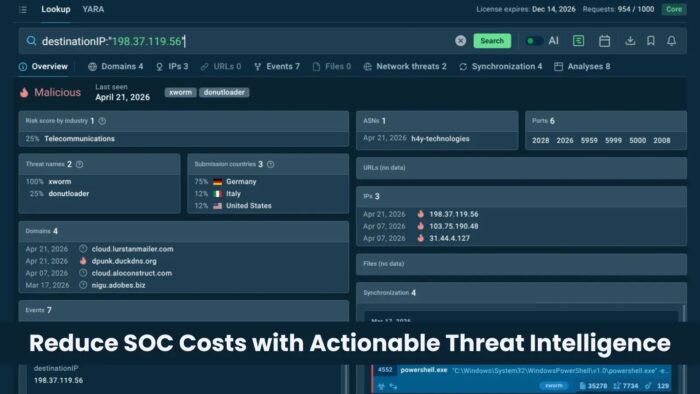
Security operations centers can reduce investigation costs by using threat intelligence that removes noise before alerts reach analysts. The goal is simple: give teams fewer false positives, better context, and faster answers during triage.
Many SOCs do not struggle because analysts lack skill. They struggle because detection tools often receive too many duplicate, outdated, or poorly explained indicators. That forces analysts to spend time checking whether an alert matters before they can decide what to do next.

Access content across the globe at the highest speed rate.
70% of our readers choose Private Internet Access
70% of our readers choose ExpressVPN

Browse the web from multiple devices with industry-standard security protocols.

Faster dedicated servers for specific actions (currently at summer discounts)
Better threat intelligence changes that workflow. When indicators come with behavioral context, relationships, and validation, teams can prioritize real threats faster and spend less time on manual enrichment.
Why SOC costs rise when threat data lacks context
Every false alert creates a cost. A Tier 1 analyst must open the alert, check the indicator, search across tools, compare telemetry, and decide whether to escalate. If the indicator has no context, the process slows down.
The same issue appears during real incidents. A suspicious IP address, domain, URL, or file hash may look important, but analysts still need to understand its behavior. They need to know whether it connects to malware, phishing, command-and-control infrastructure, or a known campaign.
When teams lack that context, they escalate more cases to senior analysts. That increases workload, delays response, and raises the cost of each investigation.
What useful threat intelligence should provide
| Threat intelligence quality | What it means for SOC teams | Cost impact |
|---|---|---|
| Relevant indicators | The feed tracks threats that affect real environments, not stale or generic noise. | Fewer wasted investigations |
| Behavioral context | Analysts see how an indicator behaves during malware or phishing activity. | Faster triage decisions |
| Low false positives | The SOC avoids flooding SIEM, SOAR, and EDR tools with weak signals. | Lower alert fatigue |
| Fast enrichment | Analysts can move from a single IOC to connected threat details in seconds. | Less manual research |
| Easy integration | Threat intelligence fits into existing SIEM, SOAR, EDR, firewall, or ticketing workflows. | Better automation and lower MTTR |
How ANY.RUN fits into the SOC workflow
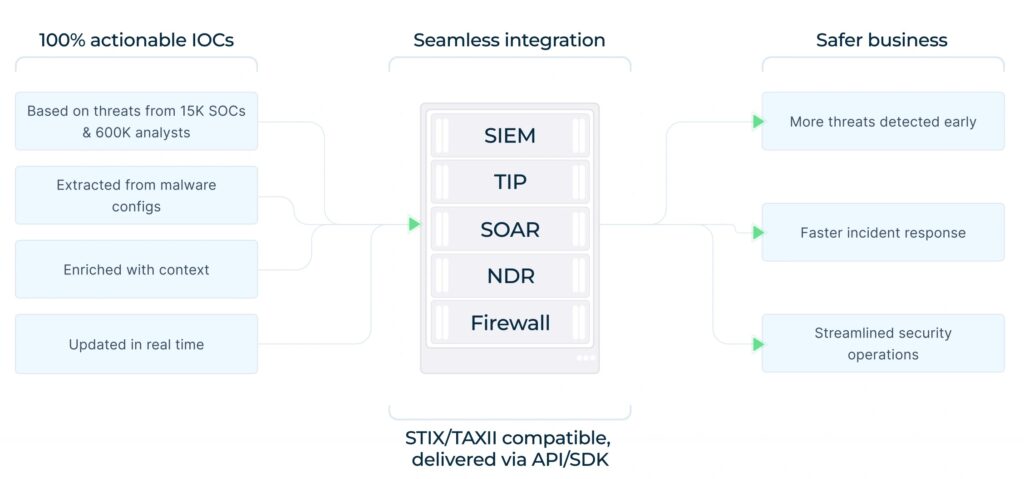
ANY.RUN offers threat intelligence through TI Feeds and Threat Intelligence Lookup. These tools focus on indicators and threat relationships collected from malware and phishing investigations.
TI Feeds help security teams block and detect malicious IPs, domains, and URLs. They also give analysts links to sandbox analysis, so an alert does not arrive as an isolated data point.
TI Lookup works more like a search layer for investigations. Analysts can enter an IP address, domain, URL, or file hash and review connected threats, related activity, and behavior-based context.
Why enriched indicators improve alert triage
Raw indicators often answer only one question: has this item appeared in suspicious activity before? That helps, but it rarely gives enough detail for confident response.
Enriched indicators answer better questions. They can show what malware family used the indicator, what network activity appeared during analysis, what files changed, and which tactics or techniques connect to the behavior.
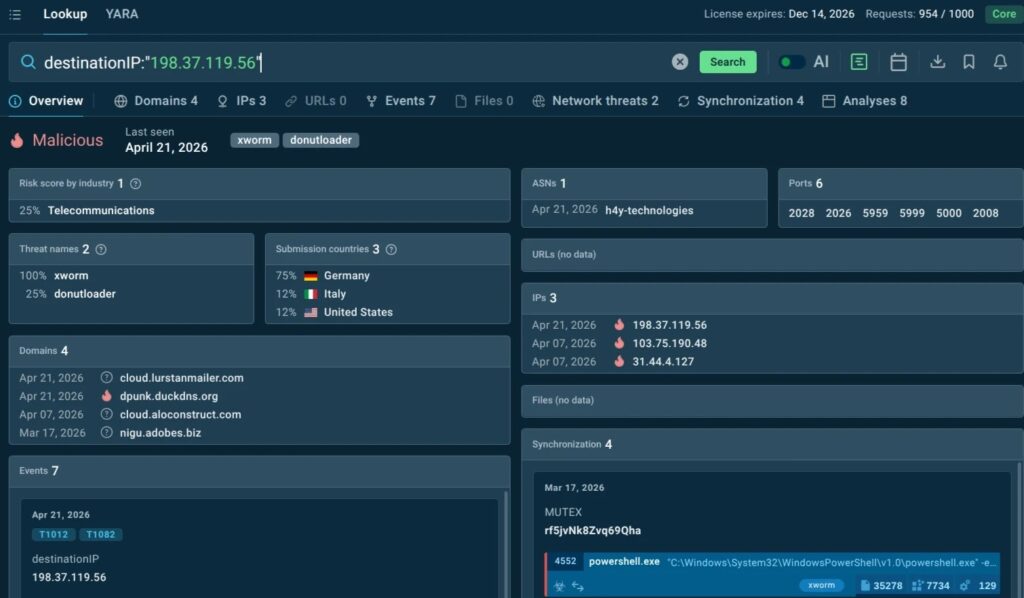
This turns triage into a decision process instead of a manual research task. Analysts can decide whether to close, monitor, escalate, or contain the alert with more confidence.
Operational benefits for SOC leaders and CISOs
| Role | Main problem | How better threat intelligence helps |
|---|---|---|
| SOC manager | Too many alerts and too few analysts | Reduces false positives and repetitive manual checks |
| Tier 1 analyst | Limited context during first review | Provides faster enrichment for IOCs and suspicious artifacts |
| Tier 2 analyst | Too many unnecessary escalations | Helps junior analysts resolve more cases independently |
| Threat hunter | Difficulty connecting weak signals | Links indicators to behavior, malware, campaigns, and infrastructure |
| CISO | High security spend with unclear impact | Improves response speed, visibility, and risk-based prioritization |
Key ANY.RUN threat intelligence capabilities
- Threat Intelligence Lookup gives analysts searchable context for indicators such as IPs, domains, URLs, and file hashes.
- ANY.RUN says TI Lookup includes more than 50 million threats and adds about 16,000 new threats daily.
- ANY.RUN says its data comes from a community of more than 600,000 researchers and 15,000 corporate clients.
- TI Feeds provide malicious IPs, domains, and URLs enriched with sandbox analysis.
- ANY.RUN describes its feeds as real-time, noise-free, and built for SIEM, SOAR, EDR, firewall, and threat hunting workflows.
- The platform also supports integrations and connectors that help teams use threat intelligence inside existing security operations tools.
How this reduces investigation cost
Cost reduction starts when the SOC removes weak alerts before analysts touch them. High-confidence feeds help detection tools focus on signals that have stronger evidence behind them.
Investigation cost falls again during enrichment. Instead of moving between multiple tools to understand one indicator, analysts can use threat intelligence that already connects the artifact to behavior and related threats.
The final gain comes from consistency. When analysts use the same intelligence layer across triage, threat hunting, and incident response, teams can standardize playbooks and reduce unnecessary escalations.
How SOC teams should measure the impact
- Track alert volume before and after adding a curated threat intelligence feed.
- Measure false positive reduction across SIEM, SOAR, and EDR workflows.
- Compare average triage time for enriched alerts and non-enriched alerts.
- Measure escalation rates from Tier 1 to Tier 2 analysts.
- Track mean time to respond for incidents involving known malicious infrastructure.
- Review how often analysts need external manual searches during investigations.
Threat intelligence works best when teams operationalize it
Threat intelligence does not reduce SOC costs by sitting in a dashboard. Teams need to connect it to detection rules, enrichment workflows, triage playbooks, and response actions.
For example, a SIEM can use a feed to match suspicious network activity against malicious domains. A SOAR workflow can enrich the alert automatically. An analyst can then open the connected sandbox report and decide the next step.
This is where curated intelligence creates measurable value. It helps teams move from alert collection to fast, evidence-based decisions.
FAQ
Behavioral context helps analysts understand what an indicator actually did during an attack. That makes response decisions faster and more reliable.
TI Feeds support automated detection and blocking through security tools. TI Lookup helps analysts search and enrich individual indicators during investigations.
A useful feed provides current, relevant, validated, and contextual indicators. It should integrate with existing SOC tools and support fast triage.
Threat intelligence reduces SOC costs by cutting false positives, speeding up alert enrichment, lowering manual research time, and reducing unnecessary escalations.


Read our disclosure page to find out how can you help VPNCentral sustain the editorial team Read more


Improve this guide




User forum
0 messages