
FishMonger Expands SprySOCKS Backdoor From Linux to Windows


 7 min. read
  Published on
FishMonger, a China-aligned cyberespionage group, has expanded the SprySOCKS backdoor from Linux to Windows, giving the group a broader toolset for spying on government and public-sector targets.
ESET researchers discovered two previously undocumented Windows variants of SprySOCKS, tracked as WIN_DRV and WIN_PLUS. ESET telemetry shows activity between 2023 and 2024, with victims in Honduras, Taiwan, Thailand, and Pakistan, mostly government organizations.

Access content across the globe at the highest speed rate.
70% of our readers choose Private Internet Access
70% of our readers choose ExpressVPN

Browse the web from multiple devices with industry-standard security protocols.

Faster dedicated servers for specific actions (currently at summer discounts)
The discovery matters because SprySOCKS was previously known as a Linux backdoor. Its move to Windows shows FishMonger has continued to invest in cross-platform espionage tools, stealthier persistence, and more flexible command-and-control options.
SprySOCKS Was First Seen as a Linux Backdoor
SprySOCKS first drew attention in 2023, when Trend Micro reported that Earth Lusca, another name used for FishMonger activity, was deploying a Linux backdoor against government entities.
Trend Micro said the Linux version appeared to be based on Trochilus, an open-source Windows remote access tool, but had been modified enough to become a distinct backdoor. The malware also included SOCKS proxy features, encrypted payload loading, and command-and-control behavior linked to espionage operations.
The new Windows variants keep several elements from the Linux version, including similar command structures, encryption logic, and communication design. They also add Windows-specific techniques that make detection and investigation harder.
| Variant | Main feature | Defender concern |
|---|---|---|
| WIN_DRV | Uses kernel drivers for stealth | Can hide processes, files, registry keys, and network connections |
| WIN_PLUS | Uses print processor abuse and DLL loading | Can persist through legitimate Windows components |
| Linux SprySOCKS | Uses a loader and encrypted payload | Shows the backdoor’s earlier cross-influence from Trochilus |
FishMonger Uses Windows Drivers for Stealth
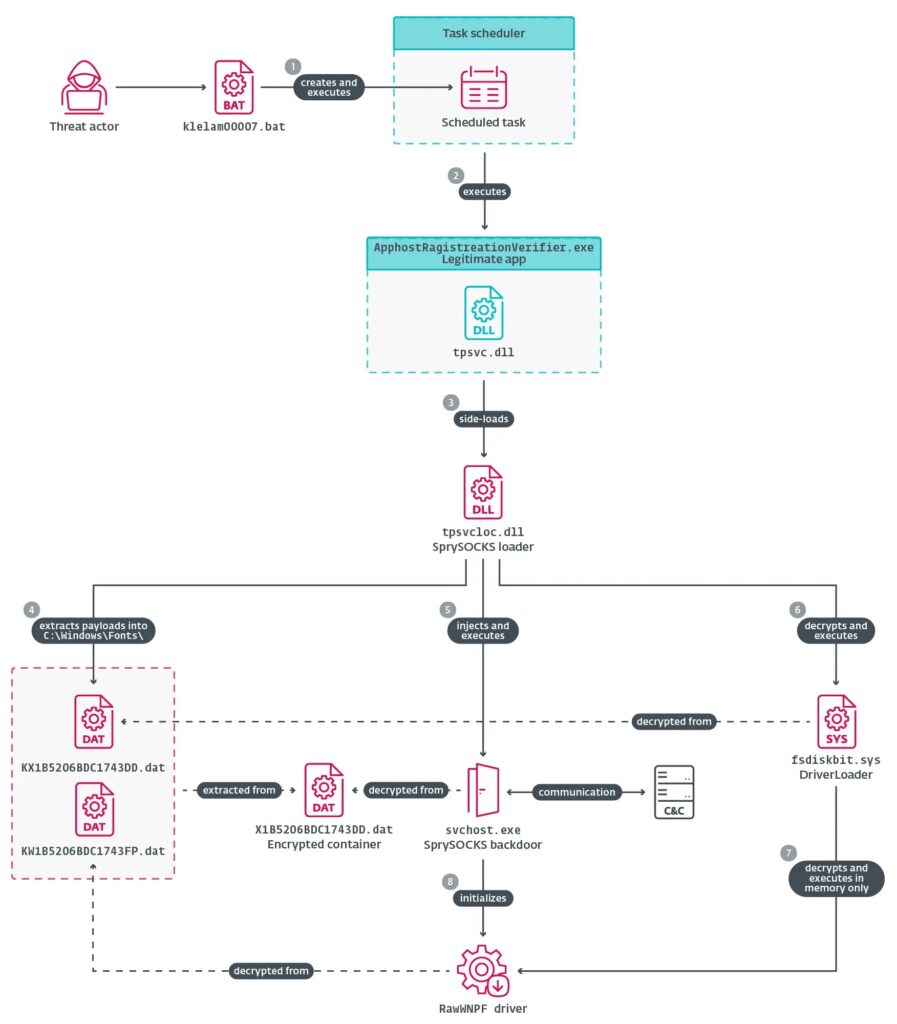
The more advanced Windows variant, WIN_DRV, uses a kernel driver called RawWNPF. This driver hides the malware’s network connections, running processes, files, and registry keys from normal Windows monitoring tools.
The driver also supports TCP traffic diversion. This lets the attackers send commands through open TCP ports without revealing the backdoor’s real listening port, making the traffic harder to trace during incident response.
The ESET analysis says the WIN_DRV version can create a stealthy passive TCP backdoor. It relies on the RawWNPF driver to redirect specially crafted packets to the hidden backdoor service.
WIN_PLUS Relies on Windows Persistence Tricks
The second Windows variant, WIN_PLUS, does not use the RawWNPF driver. Instead, it uses a different approach built around DLL loading, Windows print processor persistence, and encrypted payload storage.
The first-stage loader registers itself as a print processor through the Windows registry, then copies files into Windows spooler-related folders. It also restarts the print spooler service to trigger execution and remove traces from the original deployment location.
Both Windows variants decrypt payloads using 128-bit AES in ECB mode with a hardcoded key. They then inject the SprySOCKS backdoor into a newly created svchost.exe process using process doppelganging.
The Backdoor Supports More Than 30 Commands
SprySOCKS for Windows gives attackers a wide range of remote-control features. The backdoor can collect system information, list processes, manage services, move files, create files, delete files, transfer data, and run commands through cmd.exe.
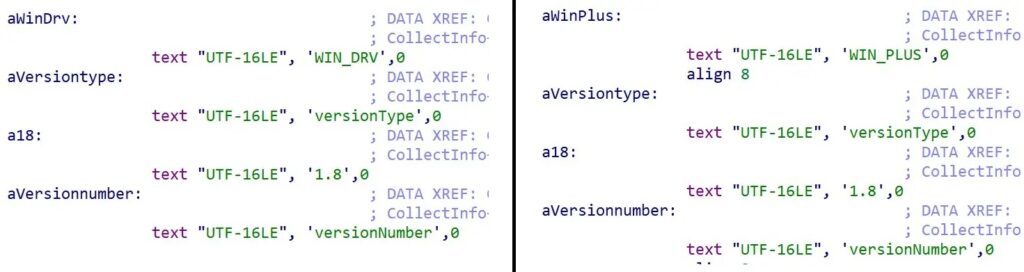
It also supports keylogging and clipboard capture, but the keylogger does not run automatically in every case. ESET says keylogging activates only when a specific configuration file exists under the user’s AppData path and contains the right key value.
The malware communicates over TCP, UDP, and WebSocket. In the WIN_PLUS variant, researchers found a hardcoded command-and-control address at 207.148.78[.]36, with communication over TCP port 443, UDP port 53, and WebSocket port 80.
- System information collection
- Process enumeration
- Service management
- File listing, creation, deletion, and transfer
- Remote shell access through cmd.exe
- SOCKS proxy support
- Keylogging and clipboard capture when enabled
- TCP, UDP, and WebSocket command-and-control channels
Possible UEFI Bootkit Link Needs Careful Handling
ESET found limited indications that some SprySOCKS attack scenarios may involve a UEFI bootkit component, possibly connected to CVE-2023-24932. That does not mean every SprySOCKS infection uses a bootkit or that exploitation has been confirmed across all observed cases.
Microsoft guidance describes CVE-2023-24932 as a Secure Boot bypass linked to the BlackLotus UEFI bootkit. Microsoft says mitigations require revoking vulnerable boot managers, which can affect some boot configurations.
For enterprises, this means Secure Boot hardening should not be rushed without testing. Microsoft’s CVE-2023-24932 protections require planning, updated recovery media, and validation across device classes before enforcement.
Who FishMonger Targets
FishMonger is associated with China-linked espionage activity and is also tracked as Earth Lusca, TAG-22, Aquatic Panda, and Red Dev 10. ESET says the group is believed to be operated by the Chinese contractor I-SOON and falls under the wider Winnti Group umbrella.
The group has previously targeted universities in Hong Kong, government entities, foreign affairs organizations, technology organizations, and telecommunications-related targets. Its broader toolkit includes ShadowPad, Spyder, Cobalt Strike, FunnySwitch, BIOPASS RAT, and SprySOCKS.
The earlier Trend Micro report also said Earth Lusca frequently targeted public-facing servers and exploited known server-side vulnerabilities. That matches ESET’s view that public-facing systems may have played a role in some Windows SprySOCKS compromises.
How Defenders Can Detect SprySOCKS Activity
Organizations should focus on both endpoint artifacts and behavior. The presence of unusual files in Windows Fonts, spooler, or AppData paths should trigger investigation, especially when paired with suspicious registry keys or unexpected print processor entries.
Defenders should also monitor for unsigned or suspicious kernel drivers, hidden network activity, process injection into svchost.exe, and abnormal communication with external IP addresses over ports 443, 53, and 80.
Public-facing servers should remain fully patched because FishMonger has a history of exploiting known vulnerabilities. Logs should also be reviewed for unusual access to web servers, VPN portals, remote management services, and administrative interfaces.
| Area to check | Suspicious sign | Why it matters |
|---|---|---|
| Windows Fonts folder | Unexpected .dat files or DLLs | WIN_DRV stores encrypted components there |
| Print processor registry keys | Unknown VSPMsg entry | WIN_PLUS can persist through print processor abuse |
| svchost.exe | Unexpected injected payload behavior | Both variants inject into svchost.exe |
| Kernel drivers | Unknown driver loading activity | WIN_DRV uses drivers to hide activity |
| Network traffic | Connections to 207.148.78[.]36 | Known C2 address in the WIN_PLUS campaign |
SprySOCKS Shows FishMonger Is Still Improving Its Toolkit
The Windows version of SprySOCKS gives FishMonger a more complete espionage toolkit. The group can now target Windows environments with stealth features that go beyond normal backdoor behavior.
For defenders, the most important lesson is practical. Patch public-facing systems, restrict administrative access, monitor driver loading, review print processor changes, and treat unusual svchost.exe activity as a high-priority signal.
FAQ
SprySOCKS is a backdoor linked to FishMonger, also known as Earth Lusca. It was first documented as a Linux backdoor and has now been found in two Windows variants called WIN_DRV and WIN_PLUS.
FishMonger is a China-aligned cyberespionage group also tracked as Earth Lusca, TAG-22, Aquatic Panda, and Red Dev 10. ESET says the group is believed to be operated by the Chinese contractor I-SOON and is part of the broader Winnti Group ecosystem.
The WIN_DRV variant uses a kernel driver to hide processes, files, registry keys, and network connections. The WIN_PLUS variant uses Windows print processor persistence and encrypted payload loading. Both variants support more than 30 remote-control commands.
ESET found limited indications that some SprySOCKS attack scenarios may involve a UEFI bootkit component, possibly related to CVE-2023-24932. This does not mean every infection uses a bootkit.
Organizations should patch public-facing servers, monitor for suspicious kernel drivers, review print processor registry entries, inspect unusual svchost.exe activity, restrict administrative access, and investigate traffic linked to known SprySOCKS infrastructure.


Read our disclosure page to find out how can you help VPNCentral sustain the editorial team Read more


Improve this guide




User forum
0 messages