
Gamaredon Uses Windows Features and Cloud Platforms to Hide Malware in Ukraine Campaign


 9 min. read
  Published on
Gamaredon is using a modular malware chain that hides inside native Windows features and relies on public cloud and messaging platforms to maintain command-and-control access. The campaign remains focused on Ukrainian government, military, and critical infrastructure targets.
The latest findings come from Sekoia.io’s first report in a three-part investigation into Gamaredon’s 2026 toolset. The company describes a fileless, VBScript-heavy infection chain that uses GammaPhish for initial access, GammaLoad for staging, GammaWorm for propagation, and GammaSteel for document theft.

Access content across the globe at the highest speed rate.
70% of our readers choose Private Internet Access
70% of our readers choose ExpressVPN

Browse the web from multiple devices with industry-standard security protocols.

Faster dedicated servers for specific actions (currently at summer discounts)
Gamaredon, also known as Armageddon, ACTINIUM, Aqua Blizzard, and UAC-0010, has targeted Ukraine for more than a decade. MITRE ATT&CK says the Ukrainian government publicly attributed the group to Russia’s Federal Security Service Center 18 in 2021.
Gamaredon rebuilt its malware into a Gamma ecosystem
Sekoia says Gamaredon has moved away from older monolithic tooling and now uses standalone malware families with separate roles. This makes the chain more flexible because each stage can retrieve new scripts, update configuration, and continue the operation even if another component fails.
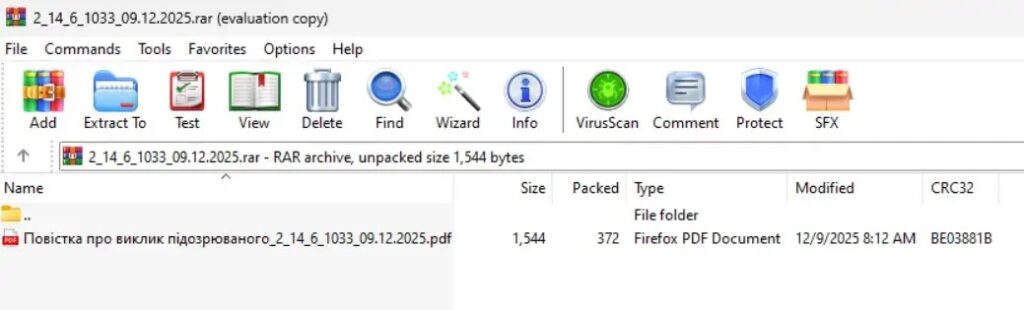
The first stage observed by Sekoia uses weaponized xHTML files. The xHTML lure triggers HTML smuggling and delivers a malicious RAR archive that abuses CVE-2025-8088 in WinRAR to place an HTA file in the Windows Startup folder.
Google Threat Intelligence previously documented widespread exploitation of CVE-2025-8088 in WinRAR. The bug is a path traversal flaw that attackers can use to write files outside the intended extraction folder, including Windows Startup locations.
| Malware family | Main role | Key behavior |
|---|---|---|
| GammaPhish | Initial access | Uses xHTML lures and a malicious RAR archive |
| GammaLoad | Staging | Loads additional VBScript and PowerShell payloads |
| GammaWorm | Propagation | Spreads across USB and network drives |
| GammaSteel | Data theft | Collects documents and exfiltrates them to cloud storage |
| GammaWipe | Destructive activity | Listed in the broader taxonomy but not the focus of this chain |
WinRAR exploitation starts the Windows chain
The RAR archive appears to contain a decoy PDF and a folder, but it also carries a hidden HTA file. When a user manually opens and extracts the archive on a vulnerable WinRAR version, the HTA file can land in the user’s Startup folder.
That HTA file runs when the user logs in again and uses mshta.exe to call remote infrastructure. This gives the operator a path to execute additional code without dropping a conventional executable as the first visible payload.
Google’s CVE-2025-8088 analysis says the flaw was patched in WinRAR 7.13 in July 2025, but threat actors continued exploiting it because many users had not updated. Organizations should treat outdated archive tools as an initial-access risk, not just a utility maintenance issue.
- A targeted user opens an xHTML lure.
- The lure smuggles a malicious RAR archive to the device.
- The archive abuses CVE-2025-8088 on vulnerable WinRAR versions.
- A hidden HTA file is written to the Startup folder.
- Windows launches the HTA file on the next login.
- The chain retrieves later Gamma payloads from remote infrastructure.
GammaWorm hides inside NTFS Alternate Data Streams
GammaWorm is the most visible shift in the campaign’s stealth model. Instead of storing many normal files, it hides key VBScript modules inside NTFS Alternate Data Streams attached to existing profile paths.
This technique maps to MITRE ATT&CK NTFS File Attributes. Alternate Data Streams can store content without changing what users normally see in Windows Explorer, which can reduce the chance that a victim or basic file scanner notices the payload.
GammaWorm also creates RunOnce registry entries and scheduled tasks that execute code from those hidden streams. It changes Explorer settings to hide file extensions, hidden files, and protected operating system files, making the infected environment look cleaner than it is.
| Windows feature abused | How Gamaredon uses it |
|---|---|
| Alternate Data Streams | Stores VBScript modules in hidden streams |
| RunOnce registry key | Relaunches GammaWorm at user logon |
| Scheduled Tasks | Runs hidden ADS modules at intervals |
| Explorer settings | Hides file extensions and protected system files |
| mshta.exe and wscript.exe | Executes script content through native Windows tools |
USB and network drive propagation increase reach
GammaWorm does not only stay on one host. It scans for USB and network drives, hides legitimate folders, and replaces them with malicious LNK shortcuts. Those shortcuts open the expected folder while quietly launching the worm again.
This design helps the malware move through shared drives and removable media, including environments where direct network access may be limited. It also uses Ukrainian-language lure names to push users into opening the shortcuts.
Sekoia’s GammaWorm analysis says the worm targets USB and network drives and uses a continuous loop that acts as a backdoor. The loop can resolve C2 infrastructure, send host fingerprints, and execute remote VBScript returned by the operator.
GammaLoad keeps staging alive through cloud dead drops
The middle of the chain relies on GammaLoad, a set of VBScript loaders that fetch and execute later stages. A second Sekoia report says GammaLoad uses a priority-based failover system that checks cached registry values before turning to public dead drop resolvers.
Those dead drops include Telegraph, Telegram, Check-Host, Cloudflare Workers, and related services. Instead of hardcoding one fixed C2 server, the malware can scrape current infrastructure from public pages and store fresh values under HKCU\Console registry keys.
That design improves resilience. If one server goes down, another script stage can still use cached values, public dead drops, or fallback infrastructure to retrieve new payloads.
- GammaLoad stores live C2 values in the Windows registry.
- It queries public services to recover fresh infrastructure.
- It executes some payloads in memory with VBScript or PowerShell.
- It can write later stages into Alternate Data Streams.
- It uses scheduled tasks to rerun hidden components.
GammaSteel focuses on document theft
The final payload in the reconstructed chain is GammaSteel, a PowerShell-based stealer. Sekoia says the malware stages 71 distinct payload functions in the HKCU\Printers registry key and encrypts them with Windows DPAPI.
The GammaSteel report says the stealer looks for user documents through three methods: recurring scans of local and network drives, monitoring newly inserted USB devices, and watching files as they are saved or modified.
Once GammaSteel finds candidate documents, it deduplicates them locally using MD5 hashes and exfiltrates data to S3-compatible cloud storage. If the main cloud path fails, it can fall back to operator-controlled servers or dead drop resolvers to continue activity.
Cloud and messaging platforms make blocking harder
Gamaredon’s infrastructure strategy mixes public platforms with operator-controlled servers. The group uses Telegram pages, Telegraph and Teletype pages, Cloudflare Workers, TryCloudflare domains, Check-Host, and S3-compatible storage as part of the command-and-control chain.
This creates a problem for defenders. Blocking every public service used in the chain may disrupt legitimate activity, while allowing them without inspection can let malware hide inside traffic that looks ordinary.
The Gamaredon Group profile notes the group’s history of using web protocols and infrastructure to support staging and C2. In the 2026 chain, that long-running pattern now appears more modular and more cloud-heavy.
| Platform or service | Observed role |
|---|---|
| Telegram | Hosts dead drop pages with C2 information |
| Telegraph and Teletype | Stores resolver pages that point to live infrastructure |
| Cloudflare Workers and TryCloudflare | Hides staging and C2 paths behind trusted infrastructure |
| Check-Host | Used as a resolver source for IP data |
| S3-compatible cloud storage | Used for document exfiltration by GammaSteel |
Detection should focus on behavior, not only indicators
Gamaredon changes infrastructure often, so defenders should not rely only on domains and hashes. Endpoint behavior can provide stronger signals, especially around ADS execution, suspicious scheduled tasks, and script interpreters launched from unusual locations.
The MITRE NTFS File Attributes technique recommends watching for suspicious file creations or modifications with colon-style stream paths and utilities that interact with streams. In this case, defenders should also inspect wscript.exe, mshta.exe, curl.exe, PowerShell, and scheduled task activity tied to ADS paths.
For compromised systems, Sekoia recommends a complete wipe as the safest remediation path because the chain has several fallback mechanisms. Partial removal may leave enough components behind for the malware to restore access.
- Update WinRAR to version 7.13 or later on all Windows systems.
- Block or inspect xHTML, HTA, RAR, and LNK files from untrusted sources.
- Hunt for RunOnce entries named ExplorerGuard.
- Monitor scheduled tasks that execute ADS paths with wscript.exe.
- Inspect USB and network drives for hidden folders and suspicious LNK replacements.
- Look for curl.exe contacting Telegram pages from user endpoints.
- Track suspicious HKCU\Console registry keys used for C2 caching.
- Consider full reimaging for confirmed GammaWorm infections.
Why Gamaredon’s 2026 toolset matters
The campaign shows how a long-running espionage group can raise persistence and stealth without abandoning familiar tactics. Gamaredon still uses phishing, scripts, USB propagation, and document theft, but it now wraps those behaviors in a layered architecture that makes cleanup harder.
The GammaLoad research shows how intermediary loaders can keep refreshing access, while the GammaSteel analysis shows the final goal: continued collection and exfiltration of sensitive documents.
For Ukrainian organizations and their partners, the main lesson is practical. Defenders need patching, script control, USB hygiene, ADS-aware forensics, and cloud traffic inspection working together, because Gamaredon’s chain deliberately crosses all of those areas.
FAQ
Gamaredon is a Russian state-backed cyber espionage group also tracked as Armageddon, ACTINIUM, Aqua Blizzard, and UAC-0010. It has targeted Ukrainian government, military, law enforcement, nonprofit, and critical infrastructure organizations for years.
GammaWorm is a VBScript-based worm used by Gamaredon. It hides modules in NTFS Alternate Data Streams, creates persistence through RunOnce entries and scheduled tasks, spreads through USB and network drives, and acts as a backdoor.
Gamaredon uses malicious RAR archives that exploit CVE-2025-8088 in vulnerable WinRAR versions. The archive can place an HTA file in the Windows Startup folder, causing code to run when the user logs in again.
Gamaredon uses public platforms as dead drop resolvers and C2 support channels. This helps the group rotate infrastructure, hide malicious traffic among legitimate services, and recover fresh server addresses if one path is blocked.
Defenders should monitor outdated WinRAR use, HTA execution, mshta.exe and wscript.exe activity, ADS paths, suspicious RunOnce keys, unusual scheduled tasks, hidden folders on USB drives, and endpoints using curl.exe to access Telegram resolver pages.


Read our disclosure page to find out how can you help VPNCentral sustain the editorial team Read more


Improve this guide



User forum
0 messages