
VPN: How to Connect (Easy Step-by-Step Instructions)


 5 min. read
  Updated on
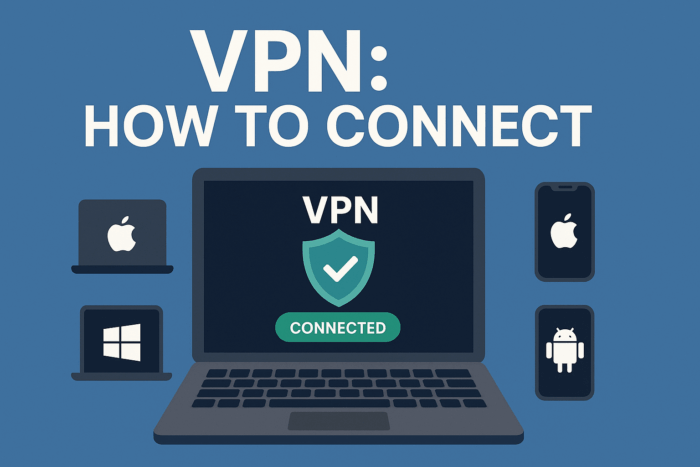
A VPN (Virtual Private Network) encrypts your internet traffic and routes it through a secure tunnel to shield your data from snooping and let you appear online from different locations. In this guide, you’ll learn how to connect to a VPN on Windows, macOS, Android, and iOS using either the provider’s app or built-in settings. We also compare free and paid VPN options, share practical tips, and answer common questions about VPN use.
Table of contents
Before You Start
Before connecting, choose a reliable VPN provider that supports all your devices and offers a trustworthy no-logs policy. Prepare your account details (username, password, and server address or configuration files). Decide whether you’ll use the VPN’s app (easiest) or create a manual profile in system settings. For a deeper walkthrough, see this guide on how to set up a VPN. Finally, confirm support for modern protocols such as OpenVPN, WireGuard, or IKEv2, and enable security features like the kill switch where available.
How to Connect on Windows 10/11
The simplest method is to use your provider’s app; Windows also supports manual setup if you prefer finer control.
- Download and install your VPN’s Windows app from the provider’s site.
- Allow system changes if prompted so the app can create a secure profile.
- Open the app, log in with your credentials, choose a server, and click Connect.
- For manual setup, open Settings > Network & Internet > VPN and click Add a VPN connection.
- Select Windows (built-in), enter the server address and login details, save the profile, then select it and click Connect.
How to Connect on macOS
On a Mac, you can configure a VPN manually or use an official app for one-click connections.
- Open System Preferences > Network (or System Settings on newer macOS versions).
- Click the “+” button and select VPN as the interface.
- Choose a VPN type such as IKEv2 or L2TP/IPSec.
- Enter the server address, account name, and authentication details from your provider.
- Save the configuration, select the new profile, and press Connect.
- Alternatively, install your VPN’s macOS app, log in, and connect with one click.
How to Connect on Android
Android supports both built-in configuration and provider apps with quick-connect features.
- Open Settings > Network & Internet > VPN.
- Tap Add VPN (or the “+” icon) to create a new profile.
- Enter a connection name, select the VPN type, and type in the server address.
- Add your username and password, then save the configuration.
- Select the profile, log in if prompted, and toggle the VPN on (look for the key icon in the status bar).
- Alternatively, install your VPN’s Android app, log in, and connect directly.
How to Connect on iOS (iPhone/iPad)
iOS offers a fast app-based method and a manual setup path for custom profiles.
- Download your VPN’s iOS app from the App Store.
- Log in, select a server, and tap Connect to establish the tunnel.
- For manual setup, open Settings > General > VPN & Device Management > VPN.
- Tap Add VPN Configuration and choose a protocol type (e.g., IKEv2).
- Enter the server address, Remote ID, and your login credentials, then save.
- Toggle the VPN on from the settings menu to connect (watch for the VPN icon in the status bar).
Tips for Better Use
Choose servers that are physically near your location to reduce latency and speed loss. Enable the kill switch so traffic is blocked if the VPN disconnects unexpectedly. Free VPNs can work for basic privacy but often include data caps or logging; premium services typically enforce stricter no-logs policies and offer faster, more reliable networks. To understand a common alternative and when it falls short, read this comparison of VPN vs Proxy. After connecting, always confirm the tunnel is active by checking that your public IP has changed.
Reliable VPNs to Try
| VPN Service | Platforms Supported | Free Trial/Plan | Logging Policy |
|---|---|---|---|
| ProtonVPN | Windows, macOS, Android, iOS, Linux | Free plan available | No logs |
| ExpressVPN | Windows, macOS, Android, iOS, Linux | 30-day guarantee | No logs |
| NordVPN | Windows, macOS, Android, iOS, Linux | 30-day guarantee | No logs |
| Windscribe | Windows, macOS, Android, iOS, Browsers | 10 GB free/month | No identifying logs |
Frequently Asked Questions
A VPN encrypts your traffic, hides your IP address, secures you on public Wi-Fi, and lets you access region-restricted content. For practical scenarios and workflows, see this explainer on how to use a VPN.
Yes, in most countries VPN use is legal. A few nations restrict or ban VPNs, so check local regulations if you travel or relocate.
Encryption adds overhead, which can reduce speed slightly. Connecting to nearby servers and using high-performance protocols usually minimizes any slowdown.
You can disconnect within your provider’s app or through your device’s VPN settings. For detailed, platform-specific steps, follow this guide on how to turn off VPN.
Most providers allow cancellation through the account dashboard or app. A step-by-step walkthrough is available here: how to cancel VPN.
Yes. Most apps let you switch servers from their location lists in one or two taps. For additional guidance, see this tutorial on how to change VPN.
Conclusion
Connecting to a VPN is straightforward on Windows, macOS, Android, and iOS, whether you use a provider app or a manual profile. Free VPNs offer a low-barrier introduction but often come with limits, while premium services provide stronger security, better performance, and reliable no-logs policies. By following the step-by-step instructions above, enabling critical features such as a kill switch, and verifying your connection after each session, you’ll keep your browsing private and your data protected across all your devices.


Read our disclosure page to find out how can you help VPNCentral sustain the editorial team Read more


Improve this guide



User forum
0 messages