
Critical Progress Kemp LoadMaster Flaw Allows Pre-Auth Root Command Execution


 8 min. read
  Published on
A critical vulnerability in Progress Kemp LoadMaster can let unauthenticated attackers run commands as root on affected appliances when the API is enabled and reachable.
The flaw is tracked as CVE-2026-8037 and affects LoadMaster GA 7.2.63.1 and earlier, along with LTSF 7.2.54.17 and earlier. Progress has released fixed versions, and administrators should upgrade immediately.

Access content across the globe at the highest speed rate.
70% of our readers choose Private Internet Access
70% of our readers choose ExpressVPN

Browse the web from multiple devices with industry-standard security protocols.

Faster dedicated servers for specific actions (currently at summer discounts)
The most severe issue is detailed in ZDI-26-342, which gives the apiuser flaw a CVSS score of 9.8 because exploitation requires no authentication and can lead to code execution as root.
Why CVE-2026-8037 is serious
Kemp LoadMaster is commonly used as a load balancer and application delivery controller. It often sits close to the network edge, where it handles application traffic, SSL and TLS offloading, health checks, content switching, and web application firewall features.
That placement makes a remote code execution flaw especially dangerous. If attackers can reach the affected API endpoint, they may not need a password or a foothold inside the target environment.
The watchTowr Labs analysis says CVE-2026-8037 is accessible to anyone who can access the API and describes the issue as a pre-authentication remote code execution vulnerability.
| Item | Details |
|---|---|
| CVE | CVE-2026-8037 |
| Product | Progress Kemp LoadMaster |
| Most severe advisory | ZDI-26-342 |
| CVSS score | 9.8 |
| Attack requirement | Network access to the affected API |
| Authentication | Not required for the apiuser issue |
| Impact | Remote command execution as root |
Which LoadMaster versions are affected?
Progress lists CVE-2026-8037 under the API and UI module in its LoadMaster vulnerabilities table. The company says fixed versions are available for both the general availability and long-term support feature branches.
The vulnerable versions are GA 7.2.63.1 and older, and LTSF 7.2.54.17 and older. The patched releases are GA 7.2.63.2 and LTSF 7.2.54.18.
The issue matters most for appliances with the API enabled. Organizations should treat any internet-exposed or broadly reachable LoadMaster API endpoint as a priority patching target.
| Branch | Affected version | Fixed version |
|---|---|---|
| LoadMaster GA | 7.2.63.1 and older | 7.2.63.2 |
| LoadMaster LTSF | 7.2.54.17 and older | 7.2.54.18 |
How the vulnerability works
The bug sits in the way LoadMaster handles input passed to the accessv2 endpoint. The vulnerable path processes the apiuser value before building a shell command.
According to ZDI-26-342, the flaw exists in the handling of the apiuser parameter provided to the accessv2 endpoint and results from memory not being properly initialized before access.
In practical terms, an attacker can shape the request so data from adjacent heap memory becomes part of the command string. That creates a path from a crafted API request to command execution as root.
- The attacker sends a crafted request to the accessv2 API endpoint.
- The apiuser value passes through a quote-escaping routine.
- The vulnerable code fails to terminate the escaped output correctly.
- The command builder can continue reading into attacker-controlled heap data.
- The resulting shell command can include the injected payload.
The patch shows the root cause
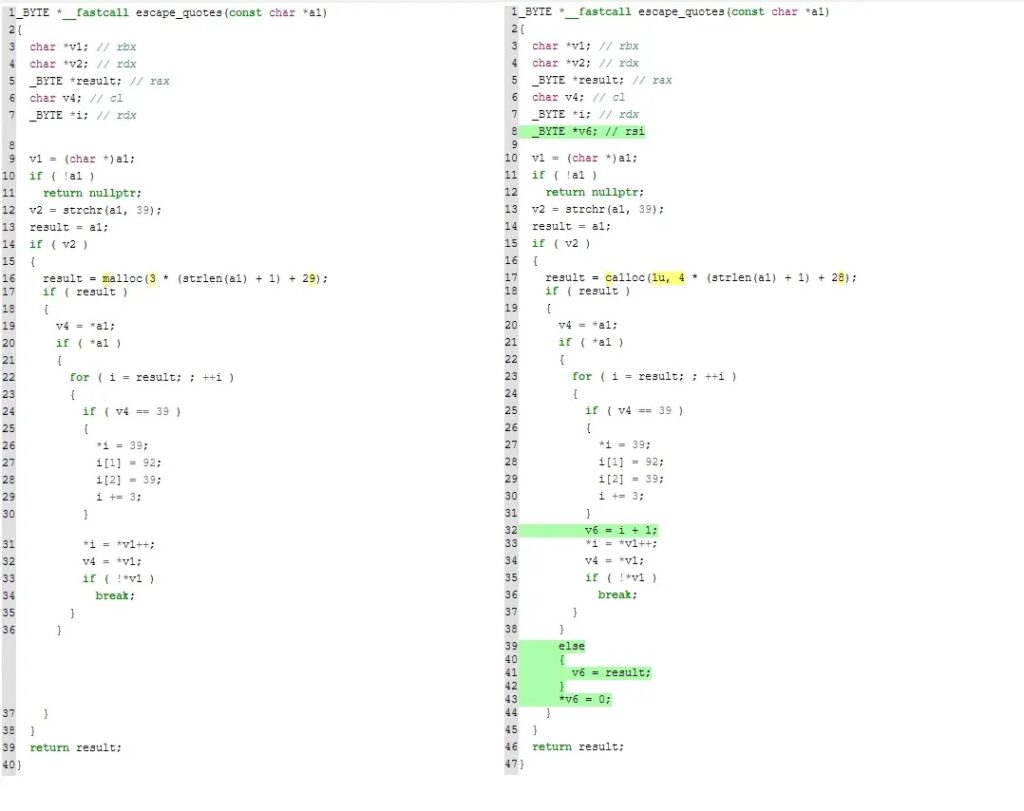
watchTowr Labs compared the vulnerable and fixed LoadMaster versions and found that the patch changed a function called escape_quotes(). That function is supposed to make user input safe before it gets placed inside a shell argument.
The vulnerable implementation used malloc and failed to add a null terminator after escaped output. The patched implementation uses zero-filled allocation and writes the missing terminator.
The technical write-up explains that four single quote characters can expand into 16 bytes during escaping, which helps overwrite allocator metadata and lets the payload reach the shell command construction path.
Progress has released the fix
Progress says it fixed CVE-2026-8037 in the 7.2.63.2 release. The company describes the issue in its LoadMaster security updates as a command injection remote code execution vulnerability in the cipher set UI and API command.
The Progress vulnerability table also lists CVE-2026-8037 as fixed in LMOS 7.2.63.2 and LMOS 7.2.54.18. That means administrators should verify both the installed version and the active update branch before assuming the appliance is safe.
The same June release also addresses CVE-2026-33691, a separate LoadMaster issue affecting the web application firewall component. Teams already scheduling maintenance should review both fixes together.
Why edge appliances need urgent patching
Load balancers and application delivery controllers can become high-value targets because they sit in front of important applications. A compromised appliance can give attackers access to traffic flows, management functions, credentials, and internal network paths.
This risk is not theoretical for edge products. Attackers frequently target VPNs, firewalls, load balancers, and other perimeter systems because they offer a direct route into enterprise environments.
Security coverage from The Hacker News also highlighted that the flaw can let attackers run root commands before authentication if they can reach the affected API.
| Risk area | Why it matters |
|---|---|
| Network edge placement | LoadMaster appliances often receive traffic before backend systems do |
| Root-level execution | Successful exploitation can give attackers high control over the appliance |
| API exposure | Reachable management or API surfaces increase the attack window |
| Traffic handling | Compromised appliances may expose sensitive application paths or credentials |
What administrators should do now
Administrators should upgrade LoadMaster appliances to GA 7.2.63.2 or LTSF 7.2.54.18 as soon as possible. They should also verify whether API access is enabled and restrict it to trusted management networks only.
The 7.2.63.2 release notes confirm that the command injection RCE issue has been fixed. Organizations without an active maintenance agreement should contact Progress or their reseller to obtain the appropriate update.
After patching, teams should review logs for unusual API requests, unexpected administrative activity, new configuration changes, and outbound connections from the appliance.
- Upgrade to GA 7.2.63.2 or LTSF 7.2.54.18.
- Disable API access if the organization does not need it.
- Restrict API and management access to trusted IP ranges.
- Block public internet access to administrative interfaces.
- Review appliance logs for suspicious accessv2 requests.
- Check for unexpected changes to certificates, virtual services, and WAF settings.
- Rotate credentials if compromise is suspected.
How to prioritize the response
Organizations should place internet-facing LoadMaster appliances at the top of the patch list. Systems with API access exposed to broad internal networks should follow closely.
The Progress vulnerabilities page confirms that a fix is available, so teams should not treat mitigation alone as a long-term answer.
Short-term network restrictions can reduce exposure while maintenance windows are prepared. They should not replace the vendor update because the vulnerable code remains present until the appliance runs a fixed version.
| Priority | Device type | Recommended action |
|---|---|---|
| Highest | Internet-facing LoadMaster with API enabled | Patch immediately and restrict API access |
| High | Internal LoadMaster with broad API reachability | Patch quickly and limit management networks |
| Medium | LoadMaster with API disabled | Patch during the next urgent maintenance window |
| Ongoing | All LoadMaster deployments | Monitor logs and keep firmware current |
What makes this flaw different from earlier LoadMaster bugs
Progress LoadMaster has faced several command injection issues in recent years, but CVE-2026-8037 stands out because the highest-severity apiuser path does not require authentication.
Some related ZDI entries for CVE-2026-8037 require privileges and carry lower scores. That distinction matters for defenders, because the pre-auth apiuser path creates a faster route from network exposure to root-level execution.
Reporting from The Hacker News notes that Progress credited Syed Ibrahim Ahmed of TrendAI Research for discovering and reporting the issue through the Zero Day Initiative.
The bottom line
CVE-2026-8037 gives attackers a high-impact path against Progress Kemp LoadMaster appliances when the vulnerable API is reachable. The combination of no authentication, network attack access, and root-level command execution makes it a patch-now issue.
Security teams should verify exposure first, but they should not wait for exploitation reports before acting. Edge infrastructure often becomes a target soon after technical details become public.
The safest response is to upgrade to the fixed LoadMaster release, restrict API access, review logs, and confirm that administrative interfaces cannot be reached from untrusted networks.
FAQ
CVE-2026-8037 is a remote code execution vulnerability affecting Progress Kemp LoadMaster. The most severe apiuser issue can let unauthenticated attackers run commands as root if they can reach the affected API.
CVE-2026-8037 affects LoadMaster GA 7.2.63.1 and older, and LTSF 7.2.54.17 and older. Progress fixed the issue in GA 7.2.63.2 and LTSF 7.2.54.18.
The highest-severity apiuser flaw documented in ZDI-26-342 does not require authentication. Other related ZDI entries tied to CVE-2026-8037 have different privilege requirements, so administrators should focus on the pre-auth apiuser issue when assessing urgent risk.
Administrators should upgrade to LoadMaster GA 7.2.63.2 or LTSF 7.2.54.18, restrict API and management access to trusted networks, and review logs for suspicious API activity.
Disabling or restricting API access can reduce exposure, but it should not replace the vendor update. The vulnerable code remains present until the appliance runs a fixed LoadMaster version.


Read our disclosure page to find out how can you help VPNCentral sustain the editorial team Read more


Improve this guide




User forum
0 messages