
Flipper One is a modular Linux cyberdeck built for networking, hacking, and open development


 7 min. read
  Published on

Flipper Devices has revealed Flipper One, a new modular Linux cyberdeck designed for hackers, security researchers, developers, and makers who need more computing power than the Flipper Zero can provide. The company describes it as a separate product category, not a direct replacement for its popular portable hacking tool.
The new device focuses on IP networking, Linux computing, hardware expansion, and open development. In its Flipper One announcement, the company says it wants the community to help shape the hardware, software, user interface, and documentation before the device reaches a finished state.

Access content across the globe at the highest speed rate.
70% of our readers choose Private Internet Access
70% of our readers choose ExpressVPN

Browse the web from multiple devices with industry-standard security protocols.

Faster dedicated servers for specific actions (currently at summer discounts)
At the center of Flipper One sits the Rockchip RK3576, an ARM system-on-chip that gives the device far more room for Linux workloads, network analysis, edge computing, and modular hardware experiments. The shift moves Flipper from offline access-control tools into a broader Linux workstation and networking platform.
Flipper One is not a Flipper Zero replacement
Flipper Devices is drawing a clear line between Flipper Zero and Flipper One. Flipper Zero remains a compact tool for offline protocols such as RFID, NFC, infrared, Sub-1 GHz radio, and wired interfaces. Flipper One targets a different layer, including Wi-Fi, Ethernet, cellular modules, VPN workflows, packet capture, and Linux apps.
The split matters because the new product is not just a faster Flipper Zero. The Flipper One project expands the idea into a portable computer with a display, physical controls, two processors, high-speed ports, and a modular expansion system.
For security professionals, that makes Flipper One more useful for network troubleshooting, lab testing, field diagnostics, and mobile research. For makers, it offers a compact Linux platform with access to interfaces that are usually spread across separate adapters and development boards.
Key Flipper One hardware specs
Flipper One uses an eight-core Rockchip RK3576 CPU with four Cortex-A72 performance cores and four Cortex-A53 efficiency cores. The official tech specs also list a Mali-G52 MC3 GPU, a 6 TOPS NPU, 8 GB of LPDDR5 RAM, and 64 GB of UFS 2.2 internal storage.
The device also includes a Raspberry Pi RP2350B low-power microcontroller. This MCU handles the display, buttons, touchpad, LEDs, power subsystem, and boot-related functions, while the main RK3576 processor runs Linux and handles heavier workloads.
| Component | Flipper One detail |
|---|---|
| Main processor | Rockchip RK3576 with 4 Cortex-A72 cores and 4 Cortex-A53 cores |
| Graphics | Mali-G52 MC3 GPU |
| AI acceleration | 6 TOPS NPU |
| Memory | 8 GB LPDDR5 |
| Storage | 64 GB UFS 2.2 plus microSD slot |
| Low-power controller | Raspberry Pi RP2350B MCU |
| Display | 256 × 144 grayscale LCD |
Networking and expansion are the main focus
Flipper One’s ports make it clear that the device targets network-heavy work. The Flipper One hardware page lists two Gigabit Ethernet ports, Wi-Fi 6 support across 2.4 GHz, 5 GHz, and 6 GHz bands, Bluetooth 5.2, USB 3.1, HDMI 2.1 output, USB-C DisplayPort Alt Mode, a SIM slot, and an M.2 expansion port.
The M.2 slot supports PCIe 2.1 x1, USB 2.0, USB 3.1, SATA3, UART, I2C, serial audio, and SIM connectivity. That gives users room to add cellular modems, storage modules, SDR hardware, and other expansion cards.
- Use it as a compact Linux workstation for field work.
- Configure it as a travel router or VPN gateway.
- Place it inline for Ethernet traffic inspection.
- Add storage, modem, or radio modules through M.2.
- Connect it to a monitor through HDMI or USB-C DisplayPort Alt Mode.
Mainline Linux is a major part of the project
The most important software promise is not just that Flipper One runs Linux. Flipper wants it to run on a mainline-first software stack, so users are not locked to an aging vendor board support package. The company explains the goal in its RK3576 mainline support documentation.
That approach should make the device easier to maintain over time. If enough hardware support reaches upstream Linux, users can rely on fresher kernels, broader distro support, better long-term fixes, and fewer private vendor patches.
Flipper’s documentation also makes clear that work remains. Mainline Linux mostly works on RK3576, but the NPU, video encoding, CSI camera, PCIe suspend, and some niche peripherals still need additional support. That means the mainline-first goal is real, but it is still an active engineering effort.
Collabora is helping upstream RK3576 support
Flipper Devices has partnered with Collabora to improve open Linux support for the Rockchip RK3576. In its Collabora announcement, the company says the RK3576 choice reflects a long-term software strategy, not only a hardware decision.
Collabora says the Flipper One operates at a different layer from the Flipper Zero and needs high-performance computing, modern graphics, Linux networking, and upstream support. It also notes that RK3576 enablement work covers areas such as the display stack, GPU, VPU, power management, and broader Rockchip support.
For developers, this partnership matters because mainline support can make Flipper One more useful beyond its launch period. A device tied to an old vendor kernel can age quickly, while a better-supported upstream platform can stay useful as Linux and user-space tools evolve.
Open development gives the community a bigger role
Flipper is also making the development process unusually visible. The company opened a public Developer Portal with task trackers, technical notes, architecture pages, documentation work, and contribution paths for people who want to follow or help the project.
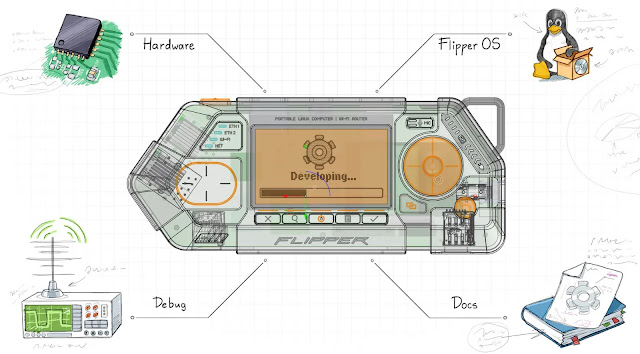
The portal separates the work into subprojects for hardware, mechanics, Linux software, MCU firmware, interface design, documentation, and testing. Flipper says engineers, developers, designers, programmers, and interested users can join the process and help shape the final product.
This gives Flipper One a different launch rhythm from many hardware products. Instead of only showing a finished gadget, the company is showing the build process while parts of the device still change.
What Flipper One could be used for
Flipper One’s planned feature set points to several practical roles. The device could work as a portable router, a VPN gateway, a packet analyzer, a small Linux workstation, or a field tool for checking unknown networks.
The mainline Linux documentation also shows why the project appeals to open-source developers. It frames the device as a platform that should support new software, new peripherals, and community contributions without depending entirely on a vendor BSP.
Security researchers may use it for network visibility and controlled lab testing. Makers may use it as a rugged Linux board with built-in controls and connectivity. Developers may use it to experiment with software that needs GPIO, networking, AI acceleration, storage, and display output in a portable device.
Flipper One still needs more work before it becomes a finished product, but the direction is clear. It aims to take the openness and community energy behind Flipper Zero and apply it to a much more powerful Linux device built for modern networking and modular hardware.
The Collabora partnership strengthens that pitch because software support will decide how useful the device remains after launch. If Flipper can deliver its mainline-first goals, Flipper One could become one of the more interesting portable Linux tools for hackers, researchers, and makers.
FAQ
Flipper One is a modular Linux cyberdeck from Flipper Devices. It is designed for networking, Linux computing, hardware expansion, security research, and maker projects.
No. Flipper One is not a direct Flipper Zero replacement. Flipper Zero focuses on offline access-control and radio protocols, while Flipper One focuses on IP networking, Linux workloads, Ethernet, Wi-Fi, cellular expansion, and modular hardware.
Flipper One uses the Rockchip RK3576, an eight-core ARM processor with a Mali-G52 GPU and a 6 TOPS NPU. It also includes a Raspberry Pi RP2350B microcontroller for low-power device control.
Flipper Devices is building Flipper One as a mainline-first Linux platform. Current documentation says mainline Linux mostly works on RK3576, but some components still need additional upstream support.
Flipper One can be used as a portable Linux workstation, VPN gateway, router, packet analyzer, Ethernet sniffer, development board, and modular hardware platform, depending on the final software and expansion setup.


Read our disclosure page to find out how can you help VPNCentral sustain the editorial team Read more


Improve this guide




User forum
0 messages