
Hackers Use ClickFix Prompt to Install MSI Package and Launch Hands-On-Keyboard Attack


 9 min. read
  Published on

A ClickFix attack observed by Huntress in May 2026 shows how one copied command can turn into a full network intrusion involving custom malware, remote access tools, lateral movement, and Defender evasion.
According to Huntress, the incident started when a user visited a compromised website and followed a fake troubleshooting prompt. The prompt told the user to press Win+R, paste a command into the Windows Run dialog, and run it.

Access content across the globe at the highest speed rate.
70% of our readers choose Private Internet Access
70% of our readers choose ExpressVPN

Browse the web from multiple devices with industry-standard security protocols.

Faster dedicated servers for specific actions (currently at summer discounts)
The first infected system had no endpoint monitoring agent installed. That gave the attacker time to install an MSI package, deploy the Potemkin loader, load RMMProject in memory, add EtherRAT, create tunnels, and move laterally before defenders gained visibility.
ClickFix Turns the User Into the Delivery Mechanism
ClickFix is a social engineering technique that tricks users into running malicious commands themselves. Instead of relying on a malicious attachment, attackers show a fake error, verification step, browser fix, or support message that tells the victim exactly what to paste into Windows.
In this case, the command abused pcalua.exe, a legitimate Windows Program Compatibility Assistant component, to launch mshta.exe. The mshta.exe utility then retrieved a malicious HTA file from attacker-controlled infrastructure.
Red Canary describes mshta.exe as a Windows-native binary used to execute Microsoft HTML Application code. Attackers often abuse it because it can run script code through a trusted Windows utility.
| Attack stage | What happened |
|---|---|
| Initial lure | User followed a fake ClickFix instruction on a compromised website |
| Command execution | The pasted command used pcalua.exe to proxy mshta.exe |
| Payload retrieval | mshta.exe fetched a malicious HTA file from attacker infrastructure |
| MSI install | The HTA downloaded and executed inst24.msi in the background |
| Loader deployment | The MSI installed the Potemkin loader and created persistence |
Potemkin Loader Delivered RMMProject in Memory
The MSI package installed a custom x64 loader that Huntress calls Potemkin. It was dropped in the user profile and persisted through a Run registry key named RunSearch.
Potemkin uses a deterministic domain generation algorithm. Huntress said the loader can generate 10,000 candidate domains from a built-in word list and probe them until it finds an active command-and-control server.
After Potemkin connects to its server, its main job is to fetch and reflectively load RMMProject. The Hacker News also reported that this ClickFix chain installs an MSI package that drops Potemkin and leads to RMMProject and EtherRAT activity.
- Potemkin was delivered through an MSI installer named inst24.msi.
- The loader persisted through HKCU Run key activity.
- It used a DGA to find a live command-and-control domain.
- It reflectively loaded follow-on modules in memory.
- Its main payload was RMMProject, a Lua-scriptable remote access tool.
RMMProject Added Browser Theft and Remote Control
RMMProject is a larger malware framework delivered by Potemkin. Huntress said it includes 15 task types, including browser credential theft, cookie stealing, process injection, remote desktop control, and runtime module loading.
The malware also included tooling to target Chromium App-Bound Encryption protections. That matters because App-Bound Encryption was designed to make browser cookie theft harder by binding secrets more tightly to the application and system context.
The broader ClickFix trend is expanding. The Hacker News report noted that recent ClickFix campaigns have also delivered other loaders, including BabaDeda and Lorem Ipsum, alongside Potemkin.
| Malware | Role in the intrusion |
|---|---|
| Potemkin | Custom loader that finds C2 infrastructure and loads modules in memory |
| RMMProject | Remote access framework with browser theft, remote desktop, and injection features |
| EtherRAT | Node.js backdoor that retrieves its C2 from Ethereum blockchain data |
| Chisel | Tunneling tool used for SOCKS proxy access during the intrusion |
| cloudflared | Renamed tunnel client used to maintain remote access into the environment |
EtherRAT Added Blockchain-Based Resilience
Five hours after the first infection, the attacker deployed EtherRAT, a Node.js backdoor. EtherRAT resolves its command-and-control server through data stored on the Ethereum blockchain, which makes traditional domain takedowns less effective.
Sysdig previously documented EtherRAT as a persistent access implant that differs from simpler payloads because it uses blockchain-based infrastructure to retrieve control information.
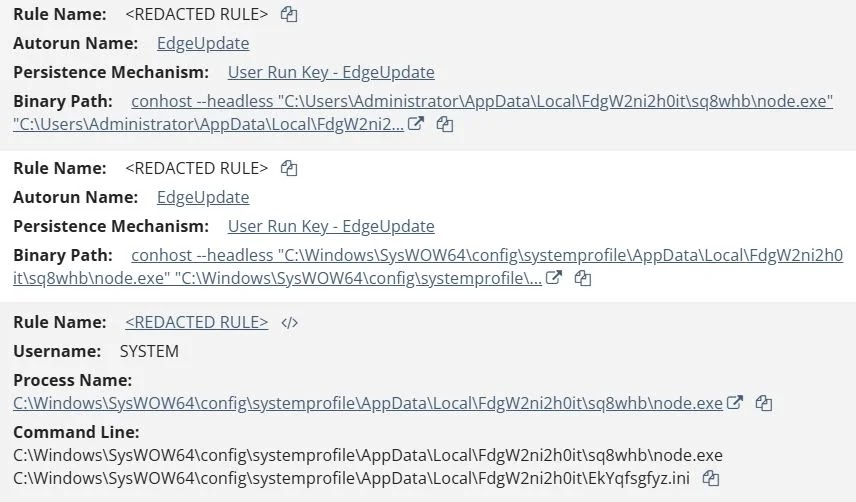
In the Huntress case, EtherRAT was delivered through a separate MSI package named cons_1.0.1.msi and persisted through a Run key named EdgeUpdate. The name helped it masquerade as a browser update component.
The Intrusion Became Hands-On-Keyboard Activity
After the initial foothold, a human operator began working through the victim network manually. Huntress observed lateral movement across 11 hosts, with the attacker using tools and behaviors consistent with WMIExec and SMBExec activity.
The operator used compromised Administrator credentials, ran reconnaissance, moved to the domain controller, and pushed malware across the environment. This shows why a ClickFix prompt should not be treated as a low-level user mistake. It can become the start of a larger intrusion.
The attacker also fought Microsoft Defender throughout the session. Microsoft’s Add-MpPreference documentation says the cmdlet can add exclusions for file paths, extensions, and processes, which explains why bulk exclusion changes can become a major detection signal when they appear unexpectedly.
- The attacker gained initial execution through the ClickFix command.
- The HTA downloaded and ran an MSI package.
- Potemkin established loader persistence.
- RMMProject provided remote access and browser theft capabilities.
- EtherRAT created a second persistent access path.
- The attacker used compromised admin credentials for lateral movement.
- Defender controls were weakened through exclusions, registry changes, and service tampering.
Cloudflare Tunnel and Chisel Helped Maintain Access
The attacker also set up a Cloudflare tunnel using a renamed copy of cloudflared. Cloudflare says Cloudflare Tunnel can connect applications and networks to Cloudflare through outbound-only connections, which makes it useful for legitimate remote access but attractive to attackers after compromise.
Chisel was also used to create SOCKS proxy access. Together, these tunnels gave the operator more than one way to reach into the environment and continue post-exploitation activity.
A renamed tunnel binary on an ordinary workstation should trigger immediate review. Cloudflare Tunnel has legitimate uses, but unexpected cloudflared activity on endpoints can indicate covert access.
Defender Evasion Was a Major Part of the Attack
The attacker repeatedly tried to weaken Windows Defender. Huntress observed AMSI patches, registry policy changes, reflective loading, Defender exclusion abuse, and attempts to stop the Defender service.
Security teams should treat mass Defender exclusion changes as suspicious, especially when paired with new Run keys, renamed tunneling tools, PowerShell scripts under ProgramData, or new MSI installs launched from temporary folders.
Microsoft’s Defender PowerShell documentation shows that exclusions can disable scanning for selected paths or processes. That legitimate administrative feature becomes dangerous when an attacker uses it to hide malware staging directories.
- Alert on pcalua.exe launching mshta.exe, PowerShell, cmd.exe, or scripts.
- Monitor mshta.exe fetching remote HTA files.
- Investigate MSI installs launched soon after browser activity.
- Alert on Run keys named RunSearch or EdgeUpdate when they point to unusual binaries.
- Review unexpected cloudflared, Chisel, or SOCKS proxy activity on endpoints.
- Treat Stop-Service WinDefend and bulk Defender exclusions as high-risk events.
- Ensure every endpoint has active monitoring before attackers get an unobserved foothold.
Indicators Linked to the ClickFix Intrusion
The indicators below are drawn from the Huntress case and should be combined with behavior-based detection. Attackers can rotate domains and filenames quickly, but the broader pattern remains clear: ClickFix prompt, pcalua.exe, mshta.exe, MSI installation, loader persistence, remote access tooling, and Defender tampering.
| Type | Indicator | Description |
|---|---|---|
| SHA256 | 2abe5dd3a057fdef935722e50e9251c272d29fd26113187b853a1f9a9cb89d9b | Potemkin loader, RunSearch.exe |
| SHA256 | 3b7ae925e2d64522b4f69b56285b05aeca8c5aab5ab46a9c02c4fafb69d881ce | RMMProject RAT, avast_update.bin |
| SHA256 | 79f7b67ce8b39070f3e1c2b90fce0ce84134782a7dedcccc1edac197ee9e089b | inst24.msi, MSI installer that drops Potemkin |
| SHA256 | 2ada24dd6e517f37942b749c2bd57ddd97445e9853002cee70a0bc30d0b0ce3a | cons_1.0.1.msi, MSI that delivers EtherRAT |
| Domain | cl.distritovagas[.]com | ClickFix HTA delivery domain |
| Domain | sonra.eutialyson[.]com | MSI download domain |
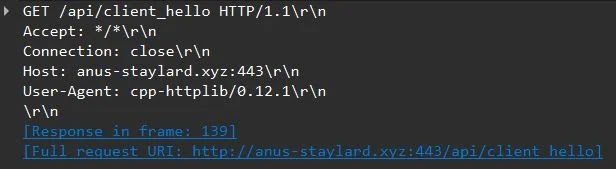
| Domain | anus-staylard[.]xyz | Potemkin and RMMProject C2 domain |
| Domain | resumeacceptable[.]com | EtherRAT C2 resolved from Ethereum blockchain data |
| IP address | 77.110.122[.]58 | Primary C2 and staging server |
| Registry key | HKCU\SOFTWARE\Microsoft\Windows\CurrentVersion\Run\RunSearch | Potemkin persistence key |
| Registry key | HKCU\SOFTWARE\Microsoft\Windows\CurrentVersion\Run\EdgeUpdate | EtherRAT persistence key |
How Organizations Can Reduce ClickFix Risk
The biggest lesson from this case is endpoint coverage. The attacker gained time because the first machine had no monitoring agent. Once visibility came online, the security team could identify and contain activity, but the initial gap shaped the damage window.
Organizations should also train users to reject browser prompts that ask them to paste commands into Run, PowerShell, Terminal, or Command Prompt. A real website should not ask a user to run a command to view a page, fix a CAPTCHA, install a browser update, or complete verification.
Huntress’ ClickFix guidance explains that the technique works because it looks like a normal online instruction. The latest Huntress intrusion report shows what can happen when that instruction runs on an unmonitored system.
Mshta monitoring should also be part of endpoint detection, especially when mshta.exe starts from pcalua.exe or reaches out to remote content. The EtherRAT research shows why blockchain-based C2 can complicate takedown efforts once a backdoor reaches the network.
FAQ
A ClickFix attack is a social engineering technique that tricks users into copying and running malicious commands in tools such as the Windows Run dialog, PowerShell, Command Prompt, or Terminal. The prompt usually pretends to be a fix, verification step, or browser update.
A user ran a malicious ClickFix command on an unmonitored endpoint. The command fetched an HTA file, installed an MSI package, dropped the Potemkin loader, loaded RMMProject, deployed EtherRAT, and led to hands-on-keyboard lateral movement across 11 hosts.
The attacker used pcalua.exe, a legitimate Windows Program Compatibility Assistant component, to indirectly launch mshta.exe. This helped the command look less obvious while still fetching and running the malicious HTA payload.
Potemkin is a custom loader, RMMProject is a Lua-scriptable remote access framework with browser theft and remote desktop features, and EtherRAT is a Node.js backdoor that retrieves its command-and-control address from Ethereum blockchain data.
Organizations should alert on pcalua.exe launching mshta.exe, mshta.exe fetching remote HTA files, suspicious MSI installs, unusual Run keys, unexpected cloudflared or Chisel activity, Defender exclusion changes, and any endpoint without active monitoring coverage.


Read our disclosure page to find out how can you help VPNCentral sustain the editorial team Read more


Improve this guide




User forum
0 messages