
Hackers Use Legitimate RMM Tools in IRS and SSA Phishing Campaigns


 8 min. read
  Published on
A phishing-as-a-service operation called The Quarry is helping cybercriminals impersonate the IRS, the Social Security Administration, DocuSign, Adobe, Microsoft, and other trusted brands to trick victims into installing legitimate remote access software.
According to SOCRadar, the operation has been active since at least April 2025 and remains active in 2026. Researchers said one developer, known as RockyBelling, Rockky, Rock, and Mike, built and maintains a modular phishing and malware-as-a-service ecosystem used by nearly 200 affiliates.

Access content across the globe at the highest speed rate.
70% of our readers choose Private Internet Access
70% of our readers choose ExpressVPN

Browse the web from multiple devices with industry-standard security protocols.

Faster dedicated servers for specific actions (currently at summer discounts)
The campaign stands out because it does not rely on traditional malware as its main payload. Instead, operators abuse ConnectWise ScreenConnect, a legitimate remote monitoring and management tool, to gain remote access to Windows systems after victims are tricked into running a fake “Security Connector.”
The Quarry Turns Phishing Into a Managed Criminal Service
The Quarry gives operators the infrastructure needed to run full phishing campaigns without building their own tools. Buyers can use phishing pages, traffic cloaking, self-hosted ScreenConnect panels, bulk email tools, payload staging systems, Telegram bots, and post-exploitation scripts.
The lures often focus on tax season. Emails impersonate IRS refund notices, SSA tax filing confirmations, W-2 workflows, and document-sharing services. However, the same backend can also support other themes, including Adobe, Dropbox, DocuSign, Microsoft, Messenger, and event invitation scams.
The SOCRadar report found more than 80 domains, more than 40 ScreenConnect panels, and more than 500 distinct victim IP addresses across 14 countries between April 2025 and April 2026. More than 90% of observed victims were in the United States.
| Campaign element | How The Quarry uses it |
|---|---|
| Government impersonation | Fake IRS and SSA pages are used to make victims trust the download prompt |
| Brand impersonation | DocuSign, Adobe, Dropbox, Microsoft, and other trusted platforms appear in lure themes |
| RMM payload | ScreenConnect is installed to give attackers remote control of the victim system |
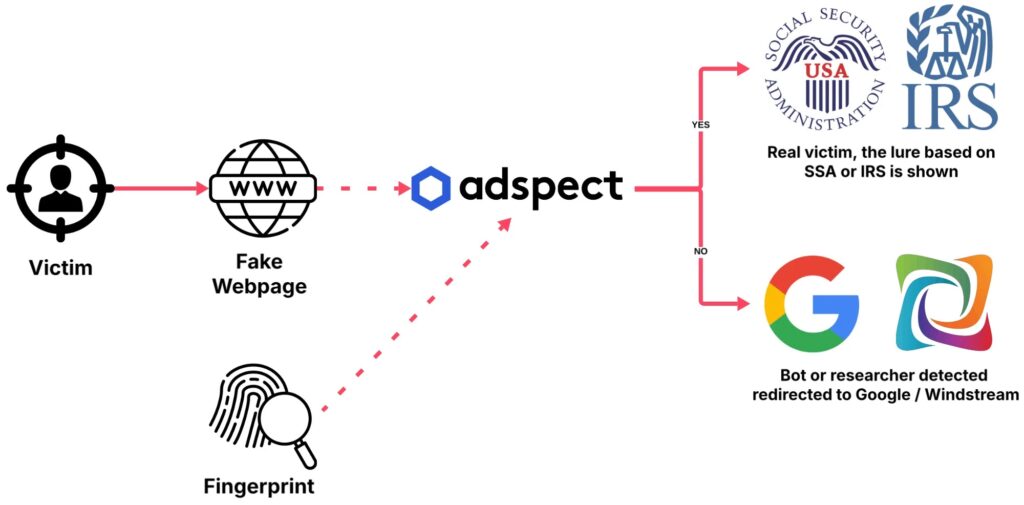
| Traffic cloaking | Adspect filters out researchers, bots, scanners, and non-Windows visitors |
| Telegram bots | Operators receive victim notifications and exfiltrated data through Telegram |
ScreenConnect Abuse Makes the Attack Harder to Detect
ScreenConnect is a real remote support platform used by businesses for IT troubleshooting and device management. That makes it useful for attackers, because security tools may treat it differently from unknown malware.
Red Canary warned that remote monitoring and management tools are legitimate administrative utilities, but attackers abuse them because they are reliable, easy to use, and capable of giving full control over a compromised endpoint.
Malwarebytes previously reported a similar SSA-themed phishing campaign that tricked users into installing ScreenConnect by pretending to offer a Social Security statement. The Quarry builds on the same idea but packages it into a broader service that affiliates can reuse across many campaigns.
How the IRS and SSA Phishing Attack Works
The attack usually starts with a phishing email. The message may claim that the recipient has a tax refund, a Social Security statement, a filing confirmation, a shared document, or another time-sensitive notice.
When the victim clicks the link, the phishing kit filters the visitor before showing the fake page. It checks whether the visitor uses Windows, then applies Adspect cloaking to separate real victims from automated scanners, sandboxes, and researchers.
If the visitor passes the checks, the fake page loads. In the SSA-themed version, the page copies government-style branding and prompts the victim to download a “Security Connector” to access a statement. The download is actually a ScreenConnect installer.
- The victim receives a phishing email impersonating the IRS, SSA, or a trusted document platform.
- The phishing site checks the user’s device and filters out unwanted visitors.
- Adspect cloaking redirects researchers and scanners away from the real lure page.
- The victim sees a fake government or document portal.
- The page prompts the victim to download and run a “Security Connector.”
- ScreenConnect installs and gives the operator remote access.
- Post-exploitation scripts can search for browser history, W-2 files, credentials, and other sensitive data.
Post-Exploitation Tools Target Tax and Browser Data
The Quarry does not stop after remote access. Researchers found post-exploitation PowerShell scripts designed to collect sensitive information after ScreenConnect is installed.
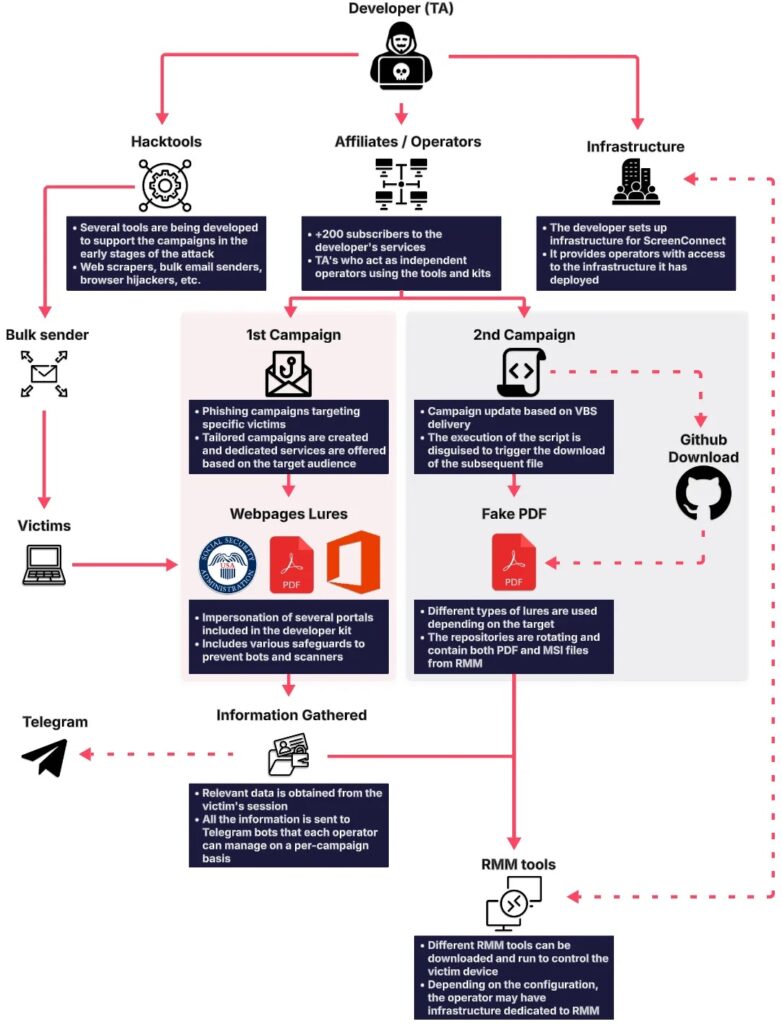
One script closes Chrome or Edge to unlock browser history databases, then extracts six months of browsing history and sends it through Telegram. Another script searches the user profile for filenames containing “w2,” a sign that attackers want tax documents containing personal, employer, and income information.
SOCRadar also reported evidence that stolen credentials and access may feed initial access broker activity. That means a successful phishing incident could later create risk from fraud groups, data thieves, or ransomware operators.
| Data or access targeted | Why attackers want it |
|---|---|
| Browser history | Shows financial services, business portals, cloud apps, and other high-value targets |
| W-2 files | Can expose Social Security numbers, employer details, and income data |
| Remote system access | Allows hands-on intrusion, credential theft, and follow-on attacks |
| AWS keys and corporate secrets | Can lead to cloud compromise, data theft, or resale to other criminals |
Government Impersonation Remains a Key Warning Sign
The real IRS tells users not to reply to suspicious tax-related messages, click links, or open attachments. The agency’s phishing guidance also says suspicious IRS or Treasury emails should be reported to [email protected].
The Social Security Administration also warns users to watch for fake calls, texts, emails, websites, social media messages, and letters claiming to come from SSA or its Office of the Inspector General.
Any email that claims to be from the IRS or SSA and asks the user to install software should be treated as suspicious. The IRS says it does not email users without permission, and the SSA scam page warns that criminals impersonate government agencies to steal personal information or money.
Security Teams Should Watch for Unauthorized RMM Tools
Organizations should maintain an approved list of remote access tools and alert on any unexpected ScreenConnect installation. That matters because RMM abuse can look like normal IT activity unless endpoint and network monitoring tools know which remote support products are allowed.
The Red Canary threat report recommends monitoring RMM activity because attackers can use these tools to access the desktop interface, command line, and files on a compromised system.
Security teams should also watch for Telegram API traffic from endpoints that do not normally use Telegram. In The Quarry campaigns, Telegram supports victim notifications and data exfiltration, so unusual HTTPS POST traffic to api.telegram.org can help identify active compromise.
- Block or alert on unauthorized ScreenConnect, Datto, Tiflux, FleetDeck, and other remote access tools.
- Investigate ScreenConnect installations that follow email clicks, browser downloads, or script execution.
- Monitor Telegram API traffic from managed endpoints.
- Restrict VBScript execution from user-writable directories.
- Train employees to distrust IRS or SSA emails that request downloads or attachments.
- Review DNS and proxy logs for fiscal, tax, SSA, portal, archive, guidance, and document-viewer domain patterns.
- Search endpoints for recent ScreenConnect MSI installs tied to unknown servers.
Indicators Linked to The Quarry Campaigns
The Quarry infrastructure uses domains that combine tax, SSA, estate, trust, inherit, portal, archive, guidance, sync, and document-verification themes. These domains should be handled carefully in defensive tools and threat intelligence systems.
| Type | Indicator | Description |
|---|---|---|
| Domain | estatetaxarchives[.]com | Tax-themed phishing infrastructure |
| Domain | hub.ssa-guidance[.]com | SSA-themed phishing infrastructure |
| Domain | inherittaxpapers[.]site | Tax document lure domain |
| Domain | verify.federal-docviewer[.]com | Fake federal document service domain |
| Domain | apps.docu-sign[.]net | DocuSign impersonation domain |
| Domain | secure.login-socialsecurity[.]com | SSA login impersonation domain |
| MD5 | 8974830446d35e234881696092aded87 | Malicious payload sample |
| MD5 | ef970697c5094c443f0456774cfee9bc | Malicious payload sample |
Defenders should avoid relying only on static indicators. Domains and hashes can change quickly, while the broader behavior remains consistent: government-themed phishing, cloaked traffic, a fake download prompt, unauthorized RMM installation, and Telegram-based reporting.
Malwarebytes Labs warned that ScreenConnect can become dangerous when criminals persuade users to install it. The Quarry shows how that tactic can scale when a developer packages phishing, delivery, access, and post-exploitation into one service.
The campaign gives organizations a clear lesson: do not treat trusted remote access tools as automatically safe. A legitimate tool installed by the wrong person can become the attacker’s remote control channel.
FAQ
The Quarry is a phishing-as-a-service and malware-as-a-service ecosystem that helps operators impersonate the IRS, SSA, DocuSign, Adobe, Microsoft, and other trusted brands. It uses phishing pages, cloaking, remote access tooling, Telegram bots, and post-exploitation scripts.
The Quarry uses ScreenConnect because it is a legitimate remote monitoring and management tool. Once installed, it can give attackers remote control while blending in more easily than traditional malware in some environments.
The campaign mainly targets users in the United States through IRS, SSA, tax, W-2, refund, and document-sharing lures. SOCRadar said more than 90% of observed victims were in the United States.
Organizations should watch for unauthorized ScreenConnect installations, suspicious Telegram API traffic, tax-themed phishing domains, unexpected VBS execution, and endpoints that download RMM tools after users click email links.
Users should treat any IRS or SSA-themed email requesting a software download as suspicious. The IRS tells users not to click links or open attachments in suspicious tax-related emails, and the SSA warns that criminals impersonate government agencies through fake emails, websites, texts, calls, and messages.


Read our disclosure page to find out how can you help VPNCentral sustain the editorial team Read more


Improve this guide


User forum
0 messages