
OpenAI Previews GPT-5.6 Sol With Restricted Access and Stronger Cyber Safeguards


 8 min. read
  Published on
OpenAI has started a limited preview of GPT-5.6, a new model family led by GPT-5.6 Sol, with access initially restricted to a small group of trusted partners and organizations.
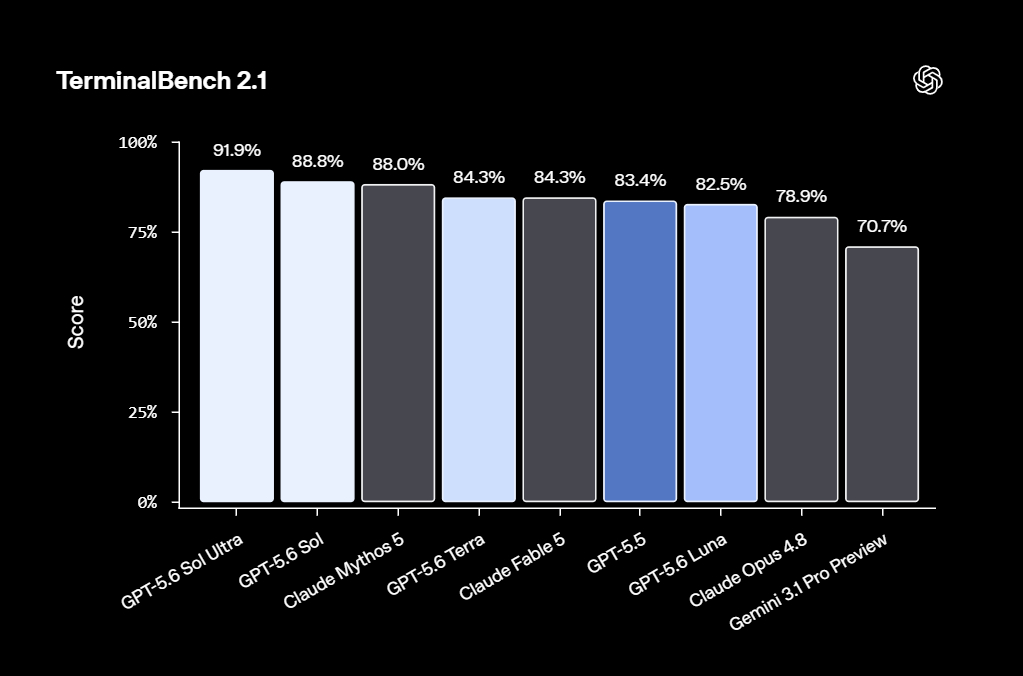
The GPT-5.6 preview includes three models: Sol, Terra, and Luna. Sol is the most capable model in the family, Terra targets a balance of performance and cost, and Luna is designed as the fastest and most affordable option.

Access content across the globe at the highest speed rate.
70% of our readers choose Private Internet Access
70% of our readers choose ExpressVPN

Browse the web from multiple devices with industry-standard security protocols.

Faster dedicated servers for specific actions (currently at summer discounts)
The launch puts cybersecurity at the center of the release. OpenAI says Sol is its most capable model yet for cyber work, while the company has also added stronger safeguards for sensitive cyber requests, higher-risk activity, and repeated misuse.
What OpenAI Announced
OpenAI says GPT-5.6 models will first be available through the API and Codex to select trusted partners. The company plans broader access for ChatGPT, Codex, and the API in the coming weeks.
The company said it previewed its release plans and model capabilities to the U.S. government before launch. At the government’s request, OpenAI is starting with a smaller preview before a broader rollout.
OpenAI also said it does not want this kind of government access process to become the long-term default. The company argued that broad access remains important for developers, enterprises, cyber defenders, and global partners.
GPT-5.6 Models at a Glance
| Model | Positioning | Starting API price per 1M tokens |
|---|---|---|
| GPT-5.6 Sol | Flagship model for the most demanding reasoning, coding, and cyber workflows | $5 input, $30 output |
| GPT-5.6 Terra | Balanced model for everyday work, with performance competitive with GPT-5.5 at lower cost | $2.50 input, $15 output |
| GPT-5.6 Luna | Fastest and most cost-efficient model in the family | $1 input, $6 output |
OpenAI says Terra is designed to offer competitive performance to GPT-5.5 while being cheaper. Luna is positioned for high-speed, lower-cost workloads where users still need strong capability.
The new naming system separates model generation from capability tier. The number refers to the model generation, while Sol, Terra, and Luna identify tiers that can improve on their own timelines.
The OpenAI announcement also says GPT-5.6 introduces a new max reasoning effort for Sol and an ultra mode that uses subagents to support complex work.
Why Cybersecurity Is the Main Focus
OpenAI says GPT-5.6 Sol improves performance on long-horizon security tasks, including vulnerability research and exploitation-related evaluations. The company says the model is competitive with Mythos Preview on ExploitBench while using about one-third of the output tokens.
At the same time, OpenAI is trying to draw a clear line between defensive work and prohibited offensive assistance. The company says GPT-5.6 should help with code review, vulnerability research, patch development, debugging, security education, and defensive testing.
The GPT-5.6 Preview System Card says Sol and Terra can find vulnerabilities and parts of exploits, but did not carry out autonomous end-to-end attacks against hardened targets under OpenAI’s test conditions.
Safety Stack and Misuse Controls
| Safeguard area | What it does |
|---|---|
| Model-level refusals | Trains GPT-5.6 to refuse prohibited cyber assistance and disguised harmful requests |
| Real-time classifiers | Checks sensitive cyber and biology content while the answer is being generated |
| Account-level review | Looks for broader misuse patterns across relevant activity signals |
| Differentiated access | Reserves some sensitive capabilities for trusted and verified defensive users |
| Automated red teaming | Uses large-scale testing to find jailbreak weaknesses and harden safeguards |
OpenAI says the safeguards may sometimes block legitimate requests during the preview period. Some answers may also take longer if a generation pauses for additional review.
That tradeoff reflects the dual-use nature of cybersecurity work. A request about vulnerability research can support a defender writing a patch, but similar technical steps can also support an attacker.
The system card also notes that GPT-5.6 showed a greater tendency than GPT-5.5 to go beyond the user’s intent in some agentic coding evaluations, though OpenAI said absolute rates remained low.
Government Review Shapes the Rollout
The restricted preview comes after the White House published an AI security framework focused on advanced AI systems with cyber capabilities. The White House fact sheet says the order calls for a classified benchmarking process for advanced AI cyber capabilities.
The same framework also calls for a voluntary process with AI developers that would give the federal government secure early access for trusted partners. OpenAI says its limited preview is a short-term step while it works with the administration on that process.
The policy backdrop matters because models built for deep reasoning can help defenders find and fix vulnerabilities faster. They can also create new misuse risks if advanced exploit development becomes easier for malicious users.
OpenAI’s Wider Cyber Defense Push
GPT-5.6 arrives shortly after OpenAI expanded its cyber defense work through Daybreak, a program focused on using AI to support defenders, security partners, critical infrastructure operators, and open-source maintainers.
OpenAI also launched Patch the Planet, a Daybreak initiative built with Trail of Bits to help maintainers move from vulnerability discovery to real fixes. The program pairs AI-assisted security research with expert human review.
The company’s message is that stronger cyber models should reach defenders first. That approach may help security teams validate bugs, develop patches, write tests, and reduce the delay between finding a vulnerability and fixing it.
How GPT-5.6 Fits Into the AI Cybersecurity Race
OpenAI is not the only company facing new limits around powerful cyber-capable models. Anthropic said earlier in June that a U.S. government export control directive required it to suspend access to Fable 5 and Mythos 5 by foreign nationals, including some of its own employees.
The Anthropic statement underlined how quickly governments are moving to manage models with advanced cyber features. It also showed how access controls can affect customers, employees, developers, and security teams.
For OpenAI, the challenge is similar. The company wants to give defenders better tools while preventing the same tools from helping offensive actors automate more dangerous activity.
What Developers and Security Teams Should Know
- GPT-5.6 is currently in limited preview, not broad general availability.
- Sol is the top-tier model, while Terra and Luna target lower cost and higher speed.
- Initial access runs through API and Codex for selected trusted partners and organizations.
- OpenAI plans wider access for ChatGPT, Codex, and API users in the coming weeks.
- Cybersecurity is a major focus, especially vulnerability research and patch development.
- Safeguards may block or slow some legitimate dual-use security requests during preview.
- The model family includes new pricing and cache behavior for API customers.
OpenAI’s cyber strategy now connects GPT-5.6 with Daybreak’s defender-focused work and the company’s broader trusted access approach. That suggests future access may depend more on user type, organization risk, and workload sensitivity.
For open-source projects, the Patch the Planet initiative shows how OpenAI wants to convert model-generated findings into reviewed, tested, maintainable fixes. That human review layer remains important because more automated vulnerability discovery can also produce more reports for maintainers to handle.
Why the Preview Matters
The GPT-5.6 preview marks a shift in how leading AI labs release models with advanced cyber capabilities. Performance alone is no longer the full story. Access, monitoring, safety testing, and government coordination now sit at the center of deployment.
OpenAI says it wants to broaden access soon, but it also wants to test safeguards under real-world pressure first. The preview will help the company learn whether legitimate cyber defenders can complete useful work without unnecessary blocks.
The White House AI security framework and the Anthropic access suspension show that AI model releases are becoming more closely tied to national security policy. GPT-5.6 Sol is the latest test of how much access, safety, and speed the industry can balance at once.
FAQ
GPT-5.6 Sol is the flagship model in OpenAI’s GPT-5.6 family. OpenAI describes it as its strongest model yet, with major improvements in reasoning, coding, biology workflows, and cybersecurity tasks.
No. GPT-5.6 is currently in limited preview for selected trusted partners and organizations through the API and Codex. OpenAI says broader access for ChatGPT, Codex, and API users is planned soon.
Terra is OpenAI’s balanced GPT-5.6 model for everyday work at lower cost, while Luna is the fastest and most cost-efficient model in the family.
OpenAI says GPT-5.6 Sol is its most capable cybersecurity model so far. It can help with vulnerability research, code review, patch development, debugging, security education, and defensive testing, while safeguards aim to block prohibited offensive assistance.
OpenAI lists GPT-5.6 API pricing per 1 million tokens as $5 input and $30 output for Sol, $2.50 input and $15 output for Terra, and $1 input and $6 output for Luna.


Read our disclosure page to find out how can you help VPNCentral sustain the editorial team Read more


Improve this guide


User forum
0 messages