
U.S. Seizes Nearly 400 Domains Used to Stream World Cup Matches Illegally


 6 min. read
  Published on
The U.S. Department of Justice has seized nearly 400 internet domains used to illegally stream FIFA World Cup matches. The action targets websites accused of offering real-time unauthorized streams while matches were being played and first broadcast.
The crackdown is part of Operation Offsides, a piracy enforcement campaign led by the National Intellectual Property Rights Coordination Center. The Justice Department announcement said the seized domains violated U.S. copyright law and were used to profit from World Cup demand.

Access content across the globe at the highest speed rate.
70% of our readers choose Private Internet Access
70% of our readers choose ExpressVPN

Browse the web from multiple devices with industry-standard security protocols.

Faster dedicated servers for specific actions (currently at summer discounts)
The 2026 FIFA World Cup is being hosted across the United States, Canada, and Mexico. The tournament runs from June 11 to July 19, according to the official FIFA World Cup 2026 page.
Operation Offsides targets illegal World Cup streams
Federal authorities said the seized sites offered copyrighted match streams without permission. Homeland Security Investigations agents confirmed that the domains were actively broadcasting World Cup matches without authorization.
The IPR Center notice said the operation aims to disrupt digital piracy domains connected to the tournament. The seizure warrant was filed in the Eastern District of Virginia.
Reuters also reported that the websites were offering live streams of World Cup matches in real time. The Reuters report said the operation involved help from FIFA, NBCUniversal, Warner Bros., and other private partners.
Why the U.S. says the domains were seized
The Justice Department framed the seizures as both an intellectual property action and a consumer safety measure. Illegal sports-streaming sites often use aggressive ads, suspicious redirects, and deceptive download prompts to monetize traffic.
HSI warned that piracy sites can expose users to malware, insecure connections, and data theft risks. That makes illegal streaming a cybersecurity issue as well as a copyright issue.
Officials said the United States has a special responsibility to protect the FIFA World Cup because it is one of the 2026 host nations. The official FIFA host cities page lists host locations across the United States, Canada, and Mexico.
Key details from the domain seizures
| Detail | What happened |
|---|---|
| Domains seized | Nearly 400 internet domains were taken down. |
| Targeted activity | The sites allegedly streamed FIFA World Cup matches without authorization. |
| Operation name | The enforcement campaign is called Operation Offsides. |
| Main agencies | The IPR Center and Homeland Security Investigations led the effort. |
| International scope | Authorities targeted infrastructure linked to multiple countries. |
The DOJ press release said FIFA assisted investigators in identifying the domains. beIN Media Group, NBCUniversal, the Motion Picture Association’s Alliance for Creativity and Entertainment, UFC, and Warner Bros. also provided supporting information.
Authorities said servers and domains linked to illegal World Cup streaming were targeted in Peru and Bulgaria. Additional disruptions took place in Croatia, Romania, Poland, and Colombia through international coordination.
The enforcement effort used the International Computer Hacking and Intellectual Property Network, which helps U.S. prosecutors coordinate with foreign law enforcement partners on cyber-enabled intellectual property cases.
What users see on seized sites
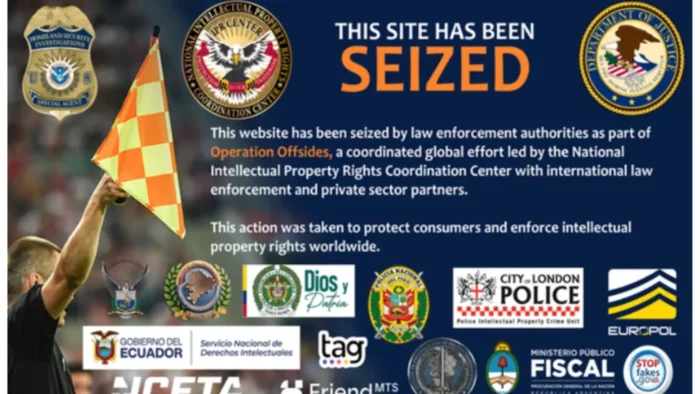
Visitors to seized domains may see a government seizure banner instead of the original streaming site. These banners typically warn that the domain has been seized under federal authority.
Such notices serve two purposes. They cut off access to the alleged piracy service and warn users that unauthorized streaming platforms can carry legal and security risks.
The IPR Center said the operation focuses on protecting intellectual property rights and keeping fans on legitimate, secure channels.
Why illegal sports streams remain a major target
Live sports create a narrow window for piracy. Illegal operators can profit from huge traffic spikes during major games, especially when viewers search quickly for free streams.
The 2026 World Cup has a larger format than previous editions, with 48 teams and 104 matches. That scale gives pirates more chances to exploit demand across different time zones and languages.
FIFA says the tournament is staged across three host countries, with matches taking place from June 11 through the July 19 final. The official FIFA tournament page confirms the schedule window.
Cybersecurity risks from illegal streaming sites
Illegal streaming sites often rely on third-party ad networks, pop-ups, browser notification traps, and fake video players. These tactics can push users toward malware, credential phishing, or unwanted software.
HSI specifically warned that users who open illegal streaming sites may expose their devices and networks to malware attacks and insecure connections. The risk becomes higher when users disable browser protections or install fake plugins to watch a stream.
- Fake play buttons can redirect users to phishing pages.
- Pop-ups may push browser notification spam or scam subscriptions.
- Malicious ads can attempt drive-by downloads.
- Unsecured connections can expose personal or financial information.
- Corporate users can introduce risk to workplace devices and networks.
International partners supported the crackdown
The domain seizures show how sports piracy now crosses borders. A website may target U.S. viewers, use infrastructure in another country, and rely on payment or advertising systems elsewhere.
That structure makes international cooperation important. The Reuters coverage noted that infrastructure connected to the operation was linked to Peru, Bulgaria, Croatia, Romania, Poland, and Colombia.
The United States, Canada, and Mexico are jointly hosting the tournament, and the official FIFA host city list shows the broad geographic footprint of the event. That scale also increases the incentive for pirate streaming networks.
What viewers should do instead
Fans should use official broadcasters, licensed streaming services, or verified tournament platforms. These options reduce security risks and support the rights holders that paid to broadcast the matches.
Users should also avoid downloading players, extensions, codecs, or VPN apps promoted by piracy sites. A legitimate stream should not require random software from an unfamiliar domain.
For businesses, the safest move is to block known piracy domains, monitor suspicious streaming traffic on corporate networks, and remind employees not to watch illegal streams from work devices.
FAQ
The U.S. Department of Justice said it seized nearly 400 internet domains that were allegedly used to stream FIFA World Cup matches without authorization.
Operation Offsides is a U.S.-led enforcement campaign targeting digital piracy domains associated with illegal FIFA World Cup streaming.
Illegal streaming sites can expose users to malware, phishing pages, insecure connections, scam ads, and fake download prompts that may compromise personal or financial data.
The operation was led by the National Intellectual Property Rights Coordination Center and Homeland Security Investigations, with support from the Justice Department and international partners.
The 2026 FIFA World Cup is being hosted across the United States, Canada, and Mexico, with matches scheduled from June 11 to July 19, 2026.


Read our disclosure page to find out how can you help VPNCentral sustain the editorial team Read more


Improve this guide



User forum
0 messages